Tuesday, August 02, 2011

Book Review – The War That Came Early 03 – The Big Switch by Harry Turtledove

The War That Came Early 03 – The Big Switch
Harry Turtledove
Genre: Alternative History
Publisher: Del Rey
Trade Paperback
418 Pages
Publication Date: July 19th, 2011
ARC Trade Paperback Uncorrected Proof
ISBN-13: 978-0345491862

image

How does he do it? Harry Turtledove, the foremost alternate history writer in the world, maintains an instinctive ability to write grand, sweeping novels incorporating larger-than-life historic events such as World War II (albeit alternate and unconventional views of the same) while still managing to compress it into the emotions, daily events, and actions of the least, common man. Master storyteller Harry Turtledove begins this series with an interesting “what if” premise and follows it through to its logical conclusion. “What if U. K. Prime Minister, Neville Chamberlain, instead of placating Hitler, had defied him by not signing the Munich Agreement in 1938?”

No other author working in the field of speculative fiction today has such an accomplished grasp of narrating the all-encompassing alternate big picture while still retaining the ability to drill down to and explain all the fears, the uncommon bravery, and the irrational behavior of the common soldier, no matter what his nationality or which country he fights for. Mr. Turtledove entwines the alternate world-view with the human condition and continues to hold our attention throughout. And few, if any, can include so many characters in such an extensive, world-wide saga and still manage to draw them all back together. In fact, there are so many characters here that I found it hard to connect with some of them. While all were intriguing some of their stories were less interesting (and satisfying to me) than others, which may be the worst thing I can say about the book.

So, here’s the thing, why I think The War That Came Early is an exceptional work of alternate fiction. If you are not extremely familiar with World War II history you’ll be convinced that things happened exactly as Mr. Turtledove chronicles in The Big Switch. That’s because the stories are stimulating, fascinating, and entirely credible works of alternate history which tend to show how minor changes in the action or inaction by prominent players (and sometimes totally improbable characters) can cause huge changes in historic events. Mr. Turtledove accomplishes this better than anyone else in the genre and tells a great story in the process.

Recommended for history buffs, military strategists, alternate historians, and fans of sprawling, blood-and-guts war fiction.

Review copy provided free as part of the LibraryThing.com Early Reader program.

4 stars out of 5

The Alternative
Southeast Wisconsin

The War That Came Early by Harry Turtledove
1. Hitler's War (2009) 4 stars out of 5
2. West and East (2010) 4 stars out of 5
3. The Big Switch (2011) 4 stars out of 5

image

Additional Reading:

Harry Turtledove Wiki

Random House Page

Harry Turtledove Website

Harry Turtledove Baen Webscription Page

Tor.com Turtledove Page

TurtleWiki

Sunday, July 31, 2011

Book Review - Crooked Little Vein by Warren Ellis

Crooked Little Vein
Warren Ellis
eBook Version
300 pages (portrait view)
Publisher: William Morrow
Publication Date: July 24, 2007
ISBN-13: 978-0060723934

clip_image002

If you’re easily offended by rude or ribald language, unconventional sexual fetishes, or buckets of blood* you may want to steer clear of both Crooked Little Vein and this review. Just sayin’… fair warnin’.

Like a violent criminal with a reputation to uphold Crooked Little Vein forced me into a secluded, dark alley and proceeded to cave my head in with the claw end of a one-pound hammer (and silly me enjoyed every second of it.) There’s nothing soft or fuzzy about this debut novel from comic book writer Warren Ellis. On the contrary, it is a blunt force instrument waiting for an audience to beat. And, thankfully, it found me. While prepping for this review (using Google and other implements of mass time annihilation) I conducted a bit of research regarding this novel. It appears that there are only two opinions pertaining to Crooked Little Vein on the Internet. Either the reviewer thoroughly hated it or totally enjoyed it. On a certain level (you know the one – where your parents taught you to be polite and “If you can’t say something nice….”) I can see why some may have disliked it. To paraphrase - Those are not the reviews you’re looking for. There’s a lot of rough, rude, randy, and rash language in Crooked Little Vein, and fetishes that reside a million miles south of main-stream wife-swapping suburbia. In addition, the central character and his beautiful side-kick experience some terribly far-fetched adventures on their way to retrieve a powerful book which contains a secret version of the United States Constitution. The tome is sought after by the White House Chief of Staff who just happens to be a functioning heroin addict with a bottomless checkbook. And he’s willing to pay big money to get the book back. Along the way, the protagonist, down-and-out P.I. Mike McGill, gets into some of the funniest, raciest, counter-cultured situations ever encountered in fiction. In my own twisted assessment all the odd circumstances, bizarre characters, and unusual events are so outlandishly creative that they make this particular work of fiction one of the most remarkable and interesting stories I’ve read in a very long time. Some might call Crooked Little Vein irreverent. Others vulgar. But there’s always room for a story that provides something innovative and curious. And boy, does this deliver. Here’s the strange thing – the principle idea – the detective or P.I. story – is a very old one yet Ellis’ concoction of urban fantasy, unrefined emotion, offensive language, bizarre situations, and out-right crappy luck suffered by the main character and his assistant is enough for me to call this one brilliant piece of neo-noir fiction.

Ellis has a solid grasp of what’s interesting, and cringe-worthy, about the steamy under-belly of America and his sharp, machine-gun style of writing fits this story perfectly. His prose is brutal, honest, tight, and lacks useless frill and decoration. A feat every author should strive to achieve. And although his characters are thrust into some of the strangest situations in modern fiction they are, by far, some of the most emotionally real characters I’ve ever encountered. Their feelings are never hidden, always worn on the sleeve, and they’re by no means afraid to say what they’re thinking or feeling. Surprisingly, beneath the surface of this extraordinary story lies a tender, albeit unorthodox, love story. Perhaps that’s what I found most interesting about the book. It has all the elements of a murder mystery quest, it forces you to realize that there is more to America than baseball, hot dogs and apple pie, and the characters are brutally honest and unexpectedly real. I thoroughly enjoyed this story and if you are one of those readers not easily offended by crude language and bizarre circumstances, or like the works of Richard Kadrey, Carlton Mellick III, or Chuck Palahniuk or agree with the majority of my book-review ratings you’ll probably take pleasure in it, as well.

4 ½ stars out of 5

The Alternative
Southeast Wisconsin

Additional Reading:

Official Author Site

Crooked Little Vein Wiki Page

Crooked Little Vein Chapter One

Crooked Little Vein Chapter Sixteen

Entertainment Weekly Review

* Okay, I know, my review has nothing in the way of ribald language, controversial sexual fetishes, or blood and gore and I apologize for that but I’m willing to bet my opening statement got you to read this far… and for those of you that did, here’s the payoff.

Q. Lewd language, fetish, and bloodshed?

A. Fertilizer, cuttlefish, bazooka.

I’ll let you determine which is which…

clip_image004

Thursday, July 28, 2011

Book Review - The Subterrene War 01 - Germline by T. C. McCarthy

The Subterrene War 01 - Germline
T. C. McCarthy
Orbit Books
373 pages
Publication date: August 1, 2011
ISBN: 978-0-316-12818-6

clip_image002

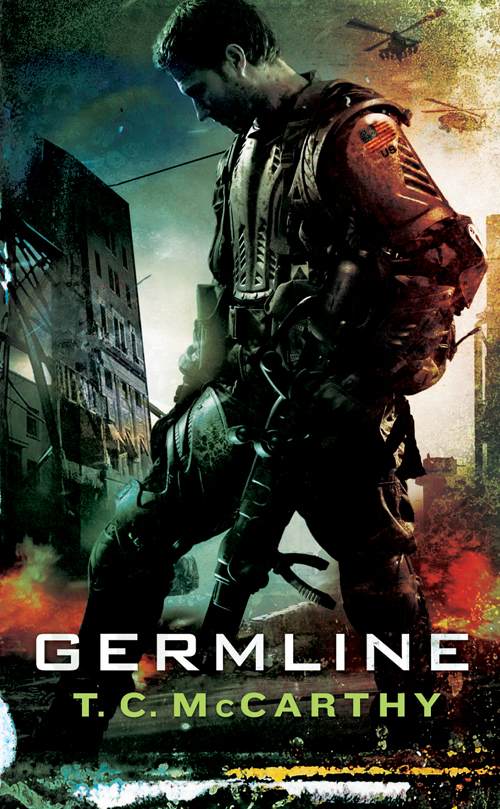
Germline, the first installment of The Subterrene War, by T. C. McCarthy is a cautionary urban-warfare epic of enormous scope. Take the HBO series Generation Kill, the blockbuster movie The Terminator, all of World War I & II, and the novel Embedded and blend them together with bio-cyberpunk-genetics, trench/tunnel warfare, and enhanced, futuristic weaponry and you have Science Fiction written for a new generation. In the very near future rare and precious metals are so expensive, so integral to technology, and so isolated by location that they are worth going to war over. In a world running low on natural resources and torn by conflict an embedded journalist from the Stars and Stripes, with heady dreams of winning the Pulitzer Prize, learns first-hand the brutality of war when he’s picked to accompany a military unit to the front lines. Once there he discovers that the war is being fought not only by normal soldiers but by genetically enhanced teen-age girls wearing smart armor and carrying weapons of beautiful design and incredible stopping power. Forced by circumstance to pick up a flechette rifle he transforms from an impartial observer to an unwilling combatant in a matter of seconds. And he knows instantly that no one will come out of this war unaffected by the death and devastation they’re about to experience.

Oscar Wendall, an embedded journalist with hopes that this assignment will propel him to prominence, becomes a combatant when a shortage of soldiers in the moments before an eminent attack leaves him no choice but to pick up a weapon and fight. But Oscar is having trouble writing about the war and his dream seems to be falling further and further from his grasp. The death, destruction, and overabundance of drugs he’s ingested won’t allow him the peace to write his masterpiece, either. In the process, Oscar is transformed from a journalist into a full-fledged civilian soldier with all the stigma that entails. At one point in the book I observed to myself that Oscar was just too damn lucky. Nobody goes through as many battles without suffering a wound as he does. (In reality many soldiers do make it through war without injury but at the time Oscar’s luck appeared almost too uncanny to be real.) He’s the only survivor of at least two battles and suffers no wounds during many fire-fights. But he does carry a lot of mental and emotional (even drug-related) baggage. Hell, he should have been admitted to the hospital a dozen times over. And then about three-fourths through the story Oscar is hit by plasma gas and suffers deep-tissue wounds to both legs. Fortunately, his friends are able to drag him from the front lines to a hospital. Fortunately, modern medicine has progressed enough that Oscar is able to recover from his wounds rather quickly. Unfortunately, the U.S. forces are almost surrounded by the enemy and Oscar still needs to track down the doppelganger of the genetically-engineered soldier he fell in love with on the front.

Germline is a war story, for certain, but not just any simple war story. It is a story of conflict over resources. It is a story of combat in the future and specifically of warfare between genetically enhanced super-warriors and normal soldiers. The war eventually lays waste to vast areas of the earth turning entire cities to scorched and burned ash. Overhead, droids drop shells filled with liquid plasma and below ground, tunnels (the subterrene) are injected with poisoned gas. Germline presents a solitary glimpse into an alternate future that is frighteningly realistic in scale. But, there is a universal theme here that pre-dates the earliest days of man and the first stone thrown in anger. This is a story of war and fear and mental illness and psychological stress and Post Traumatic Stress Disorder and of drug abuse and addiction and the human condition. It is a cautionary tale of the frailty of life and it is nothing short of brilliant. McCarthy captures the emotions, complexities, and cold, hard realities of combat down in the trenches and gives the reader, though they may have never experienced war itself, an in-depth look at the harsh realities of taking life. Germline is an engaging, compelling, and quick read and I wholly recommend it to all fans of military Science Fiction, urban warfare, genetic manipulation, future combat, embedded journalism, and to those who simply wish to be entertained by an exceptional story.

Review copy provided free as part of the Amazon Vine program.

4 ½ stars out of 5

The Alternative
Southeast Wisconsin

The Subterrene War Series by T. C. McCarthy
The Subterrene War 01 - Germline (2011)
The Subterrene War 02 - Exogene (TBA)

Additional Reading:

Germline Cover Information

Exogene Cover Information

Official Author Page

Lou Ander’s Blog Germline Post

The Founding Fields Review of Germline

The Mystery and the Magic (Agent Blog)

clip_image004

Note: I’ve heard that the Subterrene War series will follow the lives of a different character in each book and the cover of the second installment seems to indicate that Exogene will include the story of one of the genetically enhanced female soldiers we first met in Germline. I look forward to keeping up with this intriguing and exciting series.

Saturday, July 16, 2011

Book Review – Orphan’s Legacy 02 - Undercurrents by Robert Buettner

Orphan’s Legacy 02 – Undercurrents
Robert Buettner
Baen Books
Publication Date: July 1st, 2011
Trade Paperback (Uncorrected Page Proof)
291 pages
ISBN13: 978-1439134498

clip_image002

As stated in my review of the original Orphanage books last year, and by Buettner’s own admission*, the Orphanage and Orphan’s Legacy series are a deliberate homage to Robert A. Heinlein and two of his classic works of military Science Fiction, Starship Troopers and Have Space Suit - Will Travel. Thank you, Mr. Buettner, for acknowledging the deserving roots of your work and for continuing the tradition of brilliant, character-driven, combat-centric Science Fiction. Make no mistake; Robert Buettner’s Orphan books are by no means simple imitations or variations but significant and important additions to the genre in their own right. Without Starship Troopers there could be no Jason Wander or Jazen Parker and without the Orphans the next generation of military Science Fiction would be considerably weaker. The Orphan’s Legacy series is, therefore, a logical and necessary extension of those earlier works.

With that in mind I ask you to set aside the plot and events of Undercurrents for a moment (we’ll get back to them shortly, I promise) and concentrate on the author in general and the tone of his style and his storytelling in particular. Perhaps it’s because I grew up reading military Science Fiction novels and comics in the late-60’s and 70’s that I now find myself gravitating toward books written with that respectful and patriotic military approach. You know the type of story I mean – character-driven war stories filled with rough, weather-beaten, steely-eyed soldiers with chiseled-jaws and battle-scars who won’t take flack from anyone and who know how to survive in the harshest of environments. Undercurrents not only fits that mold but surpasses it. To call Robert Buettner a Master of Military Science Fiction is, in my opinion, an understatement. Not only are his books well-written, the characters are impossible to forget and their attitudes are flashback reminiscent of memorable characters like Captain America, G. I. Joe, and Sergeant Fury. What this does to - and for - me is difficult to express but there’s a certain feeling of nostalgia that I welcome every time I pick up one of his books. Doing so takes me back to a hot summer day in the seventies when I entered the local library and saw Robert Heinlein’s Starship Troopers on the shelf for the first time. I could tell by the tattered cover that it involved soldiers in space suits and I was hooked instantly (the only thing that might have made it better was if a dinosaur was on the cover as well, but that’s a different trope for a different time.) I must admit that reading Buettner’s stories takes me back to the days when I was just beginning to explore the various realms of Science Fiction and, in the process, stretching my then small but elastic mind. But I digress…

I promised to get back to reviewing the book and so, now, I will.

What happens when your covert operation turns to disaster and you’re forced to switch from battle-ready to survival-mode in less than thirty seconds? If you’re Lt. Jazen Parker you improvise. While free-falling from space Parker sees his jump-partner’s severed head and spinal column dangling from a crumpled helmet as it whizzes past. With that image burned into his memory he knows he’s been dealt a dead man’s hand. His mission? To destroy the tyrannical local government on a planet steeped in fascist politics. But all is jeopardized by two facts – his partner is now shark food and one of his ex-team members has been taken prisoner by the same government he’s been sent to destroy. And their prisoner is not just any ex-team member but one he harbors deep feelings for. Jazen must complete his mission and save his comrade before she is tortured and killed but as the details of the mission unfolds he discovers a sinister plot that might send five-hundred planetary governments into total chaos. Torn between the mission and the rescue Jazen understands that the local political leaders must be eliminated before they carry out their plan but he finds himself in charge of a broken army of rebels complete with out-dated equipment and jaded, morale-strapped soldiers. What no one realizes is just how committed Jazen is and there is no one better suited to begin or finish a war.

After reading Robert Buettner’s newest book I can only repeat, though in somewhat abbreviated form, what I’ve said before; The Orphan books display everything that’s good about exceptional military Science Fiction. Correction. They contain everything that’s good about brilliant fiction, period. Buettner writes characters that you cannot help but care for, plots that are tightly crafted, real, often gritty, dialogue that flows, and he has a true understanding of how to spin tales that are always entertaining. The guns and explosions and battle-hardened soldiers are simply a bonus for the audience. Spending a few hours with these brilliantly written works of mankind at war is time well-spent.

Orphan’s Legacy 02 - Undercurrents is available today in hardcover. Disclosure: The review copy (uncorrected page proof) used for this review was provided free as part of the Amazon Vine program.

4 ½ stars out of 5

The Alternative
Southeast Wisconsin

Additional Reading:

 * See my October 2010 review of the Orphanage Series here

* Official Robert Buettner Site
(See Buettner’s website for additional details concerning his tribute to Robert A. Heinlein.)

Robert Buettner Blog Site

Robert Buettner Wiki Page

Orphan’s Legacy 01 - Overkill Baen Webscription (eBook purchase page – Sample chapters available)

Orphan’s Legacy 02 - Undercurrents Baen Webscription (eBook purchase page – Sample chapters available)

Blog Interview with Robert Buettner

Record Freefall Attempt from Space (as featured in Undercurrents)

Heinlein’s Wiki Starship Trooper Page

Heinlein’s Wiki Have Space Suit – Will Travel Page

About the Author

Robert Buettner was born July 7, 1947 in Manhattan, grew up in Cleveland and eventually slid west to Colorado. He earned a B.A. from the College of Wooster, with Honors in geology, then studied as a National Science Foundation Fellow in Paleontology at the University of Cincinnati, earning a Juris Doctorate. He worked in mining as a rig hand and prospector in the Sonora Desert of Southwest Texas and the mountains of Alaska, and worked his way through law school as a petroleum geologist. He practiced natural resources law while serving out his Army Reserve Intelligence Commission as a Captain. He has been writing fiction since 1994. When not writing, he’s run marathons, climbed mountains, snowboarded and scuba'd. He currently lives in the foothills of the Blue Ridge north of Atlanta with his family and more bikes than a grownup needs.

Orphan's Legacy Series
1. Overkill (2011) 4 ½ stars out of 5
2. Undercurrents (2011) 4 ½ stars out of 5

clip_image003

Speculative Fiction is much like a child. We feed it and watch it mature over the years, we recognize and teach it to overcome its weaknesses, we strive to perfect its strengths, we are surprised at how smart it is, and, in the end, we hope it becomes better than us. Most of the time, it does.
- The Alternative, 2011

Tuesday, July 12, 2011

Live Music Review – Florence and the Machine, The Black Keys, Locksley, Here Come the Mummies, and Michael Franti and Spearhead

Wednesday, July 6th, 2011 – Summerfest - Milwaukee, Wisconsin

Florence and the Machine

clip_image002

Florence and the Machine opened for The Black Keys tonight and I must say that this was the most evocative and exceptional vocal performance I think I’ve ever had the pleasure to witness. Flo was in near-perfect voice and when she announced early in the show that this was the last stop of their concert tour you could tell the energy was going to hit the roof. And she did not disappoint. Floating across the stage in a beautiful flowing gown and pounding a drum at center stage Florence gave the audience everything they paid for and more. Some might even say she outdid the main act (The Black Keys – review below) but I maintain that the two are so different from each other that it didn’t matter. Anyway, her crisp, clear, haunting vocals make Florence and the Machine the best thing to hit the airwaves in years. So very glad I was able to see them live again.

Florence and the Machine
5 out of 5 stars

The Black Keys

clip_image004

The Black Keys put on a brilliant, sound-charged, and power-fused blues performance this evening before a sold out house. Drummer Patrick Carney exercised his amazing ability to create back- and off- beat fills like no other drummer I’ve ever seen and Guitarist/Vocalist (notice the capital letters here) Dan Auerbach may just be the most talented musician on the entire planet. His guitar work, both nebulous and loaded with fuzzy energy, featured bass riffs, rhythm guitar, and lead runs, often at the same time, plus (and here’s what really blows me away) he’s the singer for cryin’ out loud. They are by far the fullest and most interesting sounding blues duo in rock music today. Noteworthy and memorable selections include: Ten Cent Pistol, Everlasting Light, and Howlin’ For You.

The Black Keys
5 out of 5 stars

Thursday, July 7th, 2011 – Summerfest – Milwaukee, Wisconsin

Locksley

clip_image005

Locksley, hailing from Madison, Wisconsin and as close to a hometown group as you can get in Milwaukee, put on an electrifying and energetic performance this afternoon. This is the second time in a year we’ve seen this group and they simply get better with time. Self-labeled as a “doo-wop punk” band their songwriting is profoundly influenced by early British Invasion bands twisted around Buddy Holly rockabilly while their instrumental style is founded more on early American punk and modern garage rock. They, like the Fratellis, are a band that can write lyrical hooks without words (listen to The Whip and you’ll hear what I mean.) The first time we saw them was at the Verge Festival in June of 2010 and have since purchased their albums and made a concentrated effort to see them at Summerfest this year even though they were one of the TBD bands not found in the printed music guide. They performed songs from their album Be In Love and then a few songs from their newly released album Locksley (available July 12th, 2011.) All in all, a very enjoyable performance.

Locksley
4 out of 5 stars

Here Come the Mummies

clip_image007

I must admit that before seeing them live tonight I had never heard of Here Come the Mummies. Now that I’ve experienced their live show I have only one word to say – holy-frickin’-truly-amazing-wow!!! Rude, crude, and in the groove this nine piece Rhythm & Blues band is as entertaining as any group I've ever heard or seen, living or dead (pun intended.) This is a must-see live performance because their theatricality and stage presence is almost as entertaining as the quality of the music. With songs like Libido Knievel, Attack of the Weiner Man, and Pants (can you say triple sexual innuendo?) this band will appeal to the thirteen year old in all of us but was created for a much more mature audience. The truly outstanding quality of this band, however, is not the theatrics, or their ribald lyrics, nor their costumes. It is their profound musicality. Their sound is melodious, blood-stirring, harmonious, and perfectly in time to the beat of the audience. It’s rumored that a number of Grammy award winners are members of the group but since they all dress in mummy costumes this is hard to verify. Regardless, they have an exceptional four piece horn section, a funky rhythm section, and harmonious vocals and they entertained me and the rest of the crowd from the moment they hit the stage until the curtain fell. This is a funk/R&B show you won’t want to miss. See them if you can!

P.S. My wife and I enjoyed this show/carnival/concert/presentation so much that we purchased tickets to see them at the House of Blues in Chicago on September 17th, 2011. Can’t wait!

Here Come the Mummies
6 out of 5 stars

Michael Franti and Spearhead

clip_image008

Blending hip hop with a variety of other styles including funk, reggae, jazz, folk, and rock Michael Franti and Spearhead performed to a large audience of very lucky and highly energetic fans on the Summerfest grounds in Milwaukee tonight. He brought his signature laid-back West Coast sound and his sultry voice to the Midwest without missing a beat. Full of energy, Franti bounced his way barefoot through the first few tunes and then got down to the slower folk-rock ballads he’s known for. At one point, in the middle of the concert, Franti asked a group of young children and a few sixty-something’s to join him on stage to dance to Say Hey (I Love You). The message? Music (and love) cross every barrier of age, race, or economic status. Franti also came out into the crowd at least three times - once to serenade the folks that had to stand in the back. Michael Franti and Spearhead were a perfect exclamation point to an amazing evening of music and entertainment.

Michael Franti and Spearhead
4 ½ stars out of 5

P.S.S. Oh, and if you ever find yourself in the downtown area of Milwaukee, Wisconsin stop in at Carnevor’s for dinner, great steaks, BTW and lunch at Elsa’s on Jefferson. Best hamburgers in the state, IMO.

Additional Reading:

Music:

Florence and the Machine

The Black Keys

Locksley

Here Come the Mummies

Michael Franti and Spearhead

Other Bands of Interest at Summerfest (yes, I attended these concerts as well):

Cage the Elephant
3 ½ stars out of 5

The Mighty Blues Kings
4 out of 5 stars

Dan Rodriguez
4 out of 5 stars

The Air on Everest
3 ½ stars out of 5

Litmus Vinyl
3 stars out of 5

Food (Milwaukee):

Carnevor Steakhouse Moderne
5 out of 5 stars

Elsa’s on the Park
5 out of 5 stars

Summerfest (The World’s Largest Music Festival)
(11 stages – 11 days – over 700 bands)

Summerfest

The Alternative
Southeast Wisconsin

Monday, July 11, 2011

Book Review - My Favorite Band Does Not Exist by Robert T. Jeschonek

My Favorite Band Does Not Exist
Robert T. Jeschonek
Clarion Books
Publication Date: July 11, 2011
ARC Trade Paperback Uncorrected Proof
336 pages
ISBN: 054737027X

clip_image001

Robert T. Jeschonek’s My Favorite Band Does Not Exist is a somewhat peculiar, highly enjoyable, and intricate, multi-layered in-book fantasy within a tale within a story. Idea Deity (yes, that’s his name) has created an imaginary band that’s become an overnight, Internet sensation even though they haven’t released a single song to the public yet . Idea’s website includes fictional tour dates, invented member bios, and imaginary lyrics for a band he calls Youforia. In addition, Idea suffers from a rare disorder known as Deity Syndrome, a psychosomatic condition that makes him believe he’s a character created for a novel. To make matters infinitely worse, he’s convinced he’ll meet his demise in the middle of Chapter 64 which he fears is close. Okay, I know this sounds really weird but it gets better(read weirder)…

Elsewhere, introvert musician Reacher Miracle (yes, that’s his name) the actual leader of a band called Youforia can’t understand how someone could post so much inside information about his band, his life, and his songs on the Internet. Constantly on the run there’s no way anyone could gather so many details about the band. Reacher is determined to find the webmaster of this fake but viral website to find out how he knows so much about him and a band that has yet to play a single note in public. (Does Reacher also suffer from Deity Syndrome?)

In-book, both Reacher and Idea happen to be reading the same Swords and Sorcery fantasy novel called Fireskull's Revenant* and since both protagonists are equally invested in the book we get to read portions of the story along with them. The interspersed chapters from Fireskull's Revenant are presented with tattered, worn pages so you know when you’ve breached the in-novel fantasy which chronicles the tale of an epic battle between two superhuman/magical characters.

I must admit a certain curiosity pertaining to the link between the various disparate, in-book stories (which prompted a lot of quick page-turning to be sure) and how the author was going to pull it all together but the chain of events he created knit the different story lines together so well that they flowed into a brilliantly written, effortless, and epic conclusion(s). I was pleasantly surprised at the imaginative technique and singular skill Jeschonek employed to bring all the loose story arcs successfully together.

In some ways My Favorite Band Does Not Exist reminds me of Jasper Fforde’s Thursday Next series and Bradley Denton’s Wrack and Roll both of which I thoroughly enjoyed. The literary trope of jumping between books (while in-book) exits in Fforde’s work (although it’s a bit more complicated than that) and the out-of-control Rock ‘n Roll theme is prevalent in Denton’s. While My Favorite Band Does Not Exist contains elements of both it’s also rife with character paranoia, tribalism, fantasy, and the absurd which, in my opinion, makes it well worth the time spent reading it.

Naming conventions follow the Thomas Pynchon school of thought where character names contain symbolism (both subtle and obvious) and ultimately help define the attributes and personalities of the main characters. With names like Idea Deity, and his parents Vengeful Deity and Loving Deity, Reacher Mirage, Johnny Without, Lord Fireskull, and Eunice Truant this is evidently “meaningful naming” where the first, last, or full names say something primal about the character, often with multiple layers. In addition, the characters we meet are always more than they seem and symbolism is endemic in every name, occupation, and physical description.

As a debut urban-fantasy novel My Favorite Band Does Not Exist stands out as an ambitious and promising start for author Robert T. Jeschonek who is obviously a talented and creative writer. I, for one, would like to see his sophomore effort. As a reviewer I’m always interested in reading additional works of debut novelists so that I can follow their growth as writers, be it urban fantasy or not. What ever he plans to release next I’ll be tracking it closely.

File Under: Jasper Fforde meets Wrack and Roll meets Uber-urban fantasy meets metafiction meets Swords and Sorcery meets trashed hotel rooms. If you enjoy any of these individually you’ll love My Favorite Band Does Not Exist/ Fireskull's Revenant collectively.

My Favorite Band Does Not Exist is available today, July 11, 2011 in hardcover. Review copy provided free as part of the Amazon Vine program.

4 stars out of 5

The Alternative
Southeast Wisconsin

Additional Reading:

Robert Jeschonek Website

Fireskull’s Revenant Artwork

Accidental Rabbit Tracks Blog Review

IndieBound Page

Additional Books Containing Another Work of Fiction Within Itself:

The Laughing Man (Short Story) by J.D. Salinger

The Dark Tower by C. S. Lewis

The Crying of Lot 49 by Thomas Pynchon

Sophie’s World by Jostein Gaarder

A Clockwork Orange by Anthony Burgess

Pale Fire by Vladimir Nabokov

The Princess Bride by William Goldman

The Island of the Day Before by Umberto Eco

Steppenwolf by Herman Hesse

The Amazing Adventures of Kavalier and Clay by Michael Chabon

The Man in the High Castle by Philip K. Dick

The Hitchhiker’s Guide to the Galaxy by Douglas Adams

* Note: I’m not exactly sure how or where I got this impression but I felt that the fantasy novel Fireskull's Revenant was originally written by Mr. Jeschonek as a stand-alone story that eventually got eaten whole by the Idea/Reacher/Youforia novel and churned into the three-way fantasy My Favorite Band Does Not Exist. Then again, I’ve been known to be wrong…

Thursday, June 30, 2011

Book Review - Zombie Autopsies by Steven C. Schlozman, M.D.

Zombie Autopsies (Secret Notebooks From the Apocalypse)
Steven C. Schlozman, M.D.
Illustrated by Andrea Sparacio
Hardcover
208 pages
Grand Central Publishing
Publication Date: March 25, 2011
ISBN: 978-0446564663

clip_image002

We've seen our share of zombie survival narratives, zombie war tales, zombie diaries , and even zombie romances, as well as various guides, manuals, and required weapons lists for combating the shambling-dead. Zombie Autopsies (Secret Notebooks From the Apocalypse), on the other hand, is a story that focuses on the clinical aspects of the coming zombie apocalypse. Drawn heavily on medical, scientific, and forensic jargon, exposition, and illustrations Zombie Autopsies relies too much on the quantifiable and too little on the speculative. By that I mean that this book fails to deliver a memorable piece of fiction beneath too much scientific research and medical rationalization.

At the onset I thought the premise of zombie forensics intriguing. It was, for instance, the first time I’d seen this particular living-dead trope and thought, if handled correctly, could be a unique and entertaining story. Most of you already know that I truly do enjoy a good post-apocalyptic zombie yarn but I really had difficulty with Zombie Autopsies. Mixed in with the analytical descriptions, autopsy reports, medical illustrations, and scientific journals is an interesting fictional account of the walking-dead but the plot gets overwhelmed by too much scientific exposition. This story would have been significantly better had the percentages of technical explanation and plot-driven narrative been reversed. In all honesty, the zombie tale itself, when it does surface, is really a pretty good one and the illustrations are interesting and quite graphic but, in my opinion, the story should have guided the medical reporting rather than the other way around. Mr. Schlozman would have had a much better story had he done so.

If you enjoy all the bloody, gory details of actual autopsies, like to view cross-sectioned diagrams of cancerous or diseased organs, or are curious about the anatomical changes that might occur during the process of zombification then this book is for you. Otherwise, I’d look for other, more narrative- and less clinical- driven zombie tales to read.

2 ½ stars out of 5

The Alternative
Southeast Wisconsin

Additional Reading:

List of Zombie Novels

Ten Best Zombie Books

The Essential Zombie Book List

Friday, June 24, 2011

Book Review - Exile’s Blade - Book One - Clearwater Dawn by Scott Fitzgerald Gray

Exile’s Blade - Book One – Clearwater Dawn
Scott Fitzgerald Gray
Kindle Edition
Publisher: Insane Angel Studios
Publication Date: May 8, 2011
358 Pages (eBook version)
ASIN: B005007GHA

clip_image002

          Due to review commitments I do not get to read as much fantasy as I used to, which is really a shame. As a matter of fact the last true “fantasy” review I did was over a year ago. But, thanks to Clearwater Dawn by Scott Fitzgerald Gray I know that I’ll be picking up more in the near future, especially since this is the first book in a planned series. I recall how much fun Raymond E. Feist’s Magician was the first time I read it. That true joy of finding a well-written, creative, and stirring piece of fantasy fiction is hard to replicate. I remember being spellbound by the depth of the characters, the unique and unusual use of magic, the truly original plot, and the new worlds fully created out of nothing more than the imaginations of the author and his audience. Clearwater Dawn had much the same effect on me and, in my opinion, is every bit as good as the stories of the Riftwar series. I cannot pay more of a compliment to Mr. Gray’s work than to compare it with that classic series. The Riftwar books remain one of my all time favorite fantasy series and one of the few that I’ve read more than once. The Exile’s Blade series will be my next.

          Clearwater Dawn falls into that category of near-classic fantasy simply waiting for an audience to find it. Indeed, it’s hard to believe that this book is self-published and selling for only .99 in the Kindle store at Amazon and the Nook store at B&N. The story is clearly written by someone well-versed in the world of fantasy creation and a search of Mr. Gray’s past achievements will confirm that he is a long time author of Dungeons & Dragons manuals, campaigns, and narratives. As luck would have it, that previous experience carries over nicely into this novel. The locations are elaborate but not verbosely so and the characters are both believable and down-to-earth (including the princess who should be haughty but isn’t.) There is murder, and court intrigue, and secrets, and quests, and magic, and secret doors, and arranged marriages, and war and all the things you’d expect to find in a first-class fantasy adventure. With that said, the story is, of course, not perfect and the minor clichéd plot of a noble fugitive is trope-worthy but all-in-all the story is written well enough for that insignificant point to go relatively unnoticed. If you’re anything like me the “what’s going to happen on the next page” factor will have you turning pages furiously and the various character relationships will keep you interested until the very end. This was an enjoyable read and I’m happy to say that I’d recommend it to any and all fantasy fans (no matter age, fealty, or coat-of-arms.)

4 out of 5 stars

The Alternative
Southeast Wisconsin

Additional Reading:

About the Author (From Amazon.com)

Scott Fitzgerald Gray is a specially constructed biogenetic simulacrum built around an array of experimental consciousness-sharing techniques -- a product of the finest minds of Canadian science until the grant money ran out. Accidentally set loose during an unauthorized midnight rave at the lab, the S.F. Gray entity is currently at large amongst an unsuspecting populace, where his work as an author, screenwriter, editor, RPG designer, and story editor for feature film keeps him off the streets.

More info on Scott and his work (some of it even occasionally truthful) can be found by reading between the lines at insaneangel.com.

Websites

Clearwater Dawn Excerpt

Publisher Page - Insane Angel

Impressive list of D&D Credits

Kindle Store Link

Barnes & Noble Nook Store Link

FYI (File under “Getting to Know the Blogger”)

Some of my favorite Fantasy books include (in no particular order):

The Riftwar series by Raymond E. Feist
Riftwar Cycle
1. Magician: Apprentice & Magician (1985)
2. Silverthorn (1985)
3. A Darkness at Sethanon (1986)

Mithgar series by Dennis L. McKiernan
The Iron Tower
1. The Dark Tide (1984)
2. Shadows of Doom (1984)
3. The Darkest Day (1984)
The Silver Call
1. Trek to Kraggen-Cor (1986)
2. The Brega Path (1986)

The Shannara Trilogy by Terry Brooks
The Original Shannara Trilogy
1. The Sword of Shannara (1977)
2. The Elfstones of Shannara (1982)
3. The Wishsong of Shannara (1985)

Thomas Covenant series by Stephen R. Donaldson
The Chronicles of Thomas Covenant, the Unbeliever
1. Lord Foul's Bane (1977)
2. The Illearth War (1978)
3. The Power that Preserves (1979)

The Dark Tower series by Stephen King
The Dark Tower
1. The Dark Tower I: The Gunslinger (1982)
2. The Dark Tower II: The Drawing of the Three (1987)
3. The Dark Tower III: The Waste Lands (1991)
4. The Dark Tower IV: Wizard and Glass (1997)
5. The Dark Tower V: Wolves of the Calla (2003)
6. The Dark Tower VI: Song of Susannah (2004)
7. The Dark Tower VII: The Dark Tower (2004)

There are others, of course, and these are all works I read as a young adult but I remember them making an impact on me as some of the best books (not just fantasies) that I’d ever read. To be fair, there are many great fantasy works that are much newer than those listed above and are just as entertaining but these I recall making an impression on me as exciting and stimulating works of fiction when I was a young man. For exceptional works of memorable, newer fantasy look for anything by Emma Bull, Cherie Priest, Jacqueline Carey, Stephen Lawhead, George R. R. Martin, Harry Turtledove, S. M. Stirling, Joe Abercrombie, Markus Heitz, Stan Nicholls, Patrick Rothfuss, or China Mieville, to name a few.

Tuesday, June 21, 2011

Graphic Novel Review – Falling Skies Vols. 1 - 4 by Paul Tobin and Juan Ferreyra

Writer: Paul Tobin
Artist: Juan Ferreyra
Letterer: Nate Piekos
Colorist: Andrew Dalhouse
Cover Artist: Steve Morris
Publisher: Dark Horse Comics
Genre: Science-Fiction, Action/Adventure
ISBN-13:978-1-59582-737-1
Electronic Version (Dark Horse for iPad)

clip_image002

Falling Skies, the graphic novel created from the upcoming T.V. series, is the seminal aliens-invade-earth and human-resistance-retaliates story*. Boston - present day. A global alien invasion has destroyed every world government and major city on earth. But a handful of inexperienced freedom- fighters take up arms to combat the invaders and their powerful mechanized robots. College history professor Tom Mason and his sons are just trying to get by, to survive the devastating invasion, when they meet up with the 2nd Massachusetts Militia, a paramilitary faction determined to wipe out the aliens that have caused so much planetary death and destruction. But the militia’s supplies are running low and the unarmed population continues to grow as stragglers make their way into Boston. Tom must locate an old friend to help equip his team with the guns and ammunition needed to guarantee the survival of the human race. In the mean time, Tom’s young son is missing and disturbing word is out that the aliens are abducting children and outfitting them with strange spinal braces that are either controlling them or turning them into something non-human. Tom and the 2nd Massachusetts are in a race to both eliminate the alien threat and locate and free the imprisoned children.

In my opinion, what really makes this graphic novel an exceptional effort is the remarkable artwork. While Paul Tobin definitely has a handle on this tried-but-true story arc and knows when to be serious and when to joke around Juan Ferreyra’s art truly makes the story in this particular medium something special. The artwork is both realistic and believable and the characters, human and alien alike, come to life under his very competent hand. What I truly love about Ferreyra’s work is his infinite attention to detail. Every panel contains one or two back- or fore-ground detail drawings (flowers in windowsills, trees losing their leaves, debris and trash scattered in the roads, cracks in walls and sidewalks, etc.) that give the overall image a true sense of realism. Where other artist might wash the background Ferreyra populates his with realism. If you’re the type that’s into comics or graphic novels, appreciates exceptional artwork, and loves Science Fiction then you’ll most certainly enjoy this one.

Story - 3 stars out of 5
Art work – 5 out of 5 stars
Total – 4 out of 5 stars

The Alternative
Southeast Wisconsin
Additional Reading

Falling Skies

Falling Skies Webcomics (1)

Falling Skies Webcomics (2)

Falling Skies TV Series Preview

Falling Skies TV Series Wiki Page

Falling Skies TV Series IMDB Page

The Creators

Juan Ferreyra Art

Paul Tobin Interview

Dark Horse Comics

Dark Horse Comics

Alien Invasion Examples *

The War of the World (H.G. Wells) Free download

The War of the Worlds Radio Drama Wiki Page

Independence Day

Battle: Los Angeles IMDb Page

The Puppet Masters (Robert A. Heinlein)

Invasion From Mars IMDb Page

(John Carpenter’s) They Live!

Friday, June 17, 2011

Book Review - Burn Down the Sky by James Jaros

Burn Down the Sky
James Jaros*
Harper Voyager
2011
Mass Market Paperback
336 pages
Advance Uncorrected Proof

clip_image001

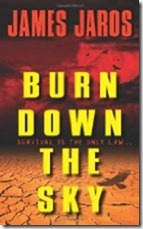
A recent incident has forced the world into post-apocalyptic regression. Most of the planet is now a vast, barren, and burnt-out wasteland. We are never told the specifics of this event though it’s implied that global warming is, for the most part, at fault. Acts of barbarism are at an all-time high. Civilized humans struggle to survive but fight a losing battle. Cults, cannibals, and crazies roam this harsh, lawless environment. The civilized build protective walls around pockets of attainable water, tend wilted crops, and scrape out the most basic existence imaginable. The uncivilized simply take whatever they want; take what others have worked so hard to keep. The continued survival of the human race appears bleak and the back-breaking work of day-to-day subsistence is the only future anyone has to look forward to. Amidst all this turmoil, and to add insult to planetary injury, a sexually-transmitted virus one thousand times deadlier and faster than AIDS has turned sex into a painful, gruesome death-sentence. However, girls who have experienced their first menstrual period in the past twelve months are immune from the plague and are therefore highly desirable to marauders and other men of ill-repute. Rather than protected as saviors of the human race they are abducted from their homes and traded to the most powerful as playthings or as simple vessels of progeny. The stakes grow when a small, struggling community comes under attack by raiders and a group of young, pre-menstrual girls is kidnapped. The mother and sister of one of the abducted girls will stop at nothing to follow the kidnappers and secure her safe return.

To be honest, when I first read the premise in the opening chapter of Burn Down the Sky I thought, That’s a very weak assertion to base a novel on. Biology just doesn’t work that way, does it? Sex deadly? Well, yes, it can be, so wear protection. Oh yeah, the world has stopped production of everything. No more condoms. Wait, what about all those in grocery and convenience stores? Oh, the cities have all been burned to the ground during the food riots. However weak the original plot device might have felt in my mind it was long-forgotten before I was half-way through chapter two. The story became so immediately interesting to me that my questions were quickly forgotten. And then, to my surprise, all my objections were logically addressed and promptly answered in the course of the next few chapters. In some ways I felt the author knew these objections were obvious and that they would quickly occur to the audience. That Mr. Jaros recognized and addressed them early made my reading of the story that much more enjoyable.

You should know up-front that this story is not for the weak or faint of heart. There are quite a few gruesome, shocking, even grotesque moments in the pages of this book and there’s a lot of action and many scenes of intense violence. There’s death by fire and by explosion, there’s dismemberment, torture, death by gun shot and by beheading. Worse, there is life after rape, life after disfigurement, and life filled with unmitigated fear. Parents with young girls are strongly cautioned. Really bad things happen to some of the children in this story. (Some good things happen, as well, but telling you more would spoil things.) In a genre that is usually top-heavy with male characters I enjoyed seeing the woman’s perspective here and Jaros does a great job of creating strong, believable women role-models with real emotions. But, I also must say that combined with the violence and despair there are some very well-written scenes of redemption, perseverance and, of course, love. The atmosphere of Burn Down the Sky is somewhat reminiscent of Cormac McCarthy’s The Road but only in the sense that each of the worlds have been turned into wastelands and scenes from Mad Max are also recognizable in that the marauders are mostly viscous, cruel, violent, and a bit “touched in the head.” In the end I really could not put this book down. Fortunately for me, since I otherwise would have suffered a few more sleepless nights, it’s a rather quick read. Burn Down the Sky is a fun, well-written, post-apocalyptic quest story that entertains and I strongly recommended it for fans of Stephen King’s The Stand, the Mad Max films, Cormac McCarthy’s The Road, or Margaret Atwood’s Oryx and Crake.

4 out of 5 stars

The Alternative
Southeast Wisconsin

Additional Reading:

Author Interview – Burn Down the Sky

Burn Down the Sky Sample

Official Author Site

Author Blog Page

A Word From the Author

* James Jaros is the pen name used by journalist and author Mark Nykanen.

Wednesday, June 15, 2011

Website Review – TVTropes.org

Website Review
TVTropes.org
Fiction Writing Help Guide
(and so much more)

clip_image001

TVTropes.org

Want to write good fiction? Want to write, research your subject, and be entertained while doing so? Then head on over to TVTropes.org and get lost for a week or two browsing the immense catalog of available tropes. What is TVTropes.org, you ask? Simply put it’s an encyclopedic index of the “tricks of the trade” for writing fiction. It’s a guide for “what not to do, what to do, what to look out for, and what to avoid” when you’re writing and researching your work of fiction. (Note, according to the site: “Tropes are devices and conventions that a writer can reasonably rely on as being present in the audience members' minds and expectations.”) All will become very clear once you start delving into this amazing site. And, don’t be put off by the name either, while it’s called “TV Tropes” the site covers and lists examples from every branch of entertainment you could possibly name, including: anime and manga, comic books, fan fic, literature, film, live-action TV, music, webcomics, video games, Western animation, and even Real Life. Want to know about the clichés concerning ammunition or weapons, the worst plot devices, gods or deities, specific apocalypse types, alien classes, or any other subject under the sun? Then this is the place for you. I really can’t remember ever finding such a useful, humorous, intelligent, and complete writing tool as this website. And, this is by no means an exaggeration!

Specifically, I suggest you check out the “Speculative Fiction category of the site (left-hand sidebar near the bottom). You’ll find hundreds of subjects including tropes on Area 51, Alien Autopsy, Benevolent Alien Invasion, Captain's Log, Did You Just Punch Out Cthulhu? , and  The End of the World as We Know It, to name just a few. This single list alone will keep you busy for many, many days. Not only will you become educated in the myriad ways Area 51 has been used in entertainment but you’ll also learn why Every Bullet is a Tracer and why All Myths Are True. There’s even an entire catalog of Discovery Channel Mythbusters tropes found here.

Some of my favorite Speculative Fiction topics include: The Grand List of Overused Science Fiction Clichés , The Turkey City Lexicon , Imperial Stormtrooper Marksmanship Academy , Did Not Do the Research  (which includes hundreds of sub-tropes), and Apocalypse How (which defines the various categories of apocalyptic devastation.)

If you’ve followed this blog for any length of time you’ll know that in the five years I’ve been posting to Blogger I’ve never reviewed a website before. That alone makes  TVTropes.org very special. I spend a lot of time reading and writing book reviews, my true passion, that I sometimes forget to note some of the more interesting things I’ve found. Not this time! When I found this site I knew I had  share it with you. So, here’s me telling you with complete confidence that I have never, ever run across a subject-dedicated website as entertaining, fascinating, and informative as this. TVTropes.org is a fantastic tool for fiction writers and an entertaining place for anyone interested in the written word. There truly is something for everyone here. Trust me, you’ll get lost in its pages for days and thank me for it later. After visiting TVTropes.org I dare you to come back here and not post something positive about TV Tropes in the comments…

6 freakin’ awesome stars out of 6

The Alternative
Southeast Wisconsin

The website can be found here: TVTropes.org

Tuesday, June 07, 2011

Book Review - The Graduate Student by James Polster

James Polster
The Graduate Student
AmazonEncore
Publication Date: June 21, 2011
Trade Paperback
360 pages
ISBN: 9781935597537
Advance Reader’s Copy – Uncorrected Proof


clip_image001

When the rainforest slams head-first into Hollywood and neuro-robotics take over where anthropology ends… well, you know something unusual is bound to happen. And, in this case, what happens is not only outlandish but amusing as well. The Graduate Student follows the chaotic antics of Blackwell James as his life takes an unexpected and improbable twist. From near-destitute, almost unemployable, jungle-trekking grad student to overnight Hollywood movie producer and director of a scientific project Blackwell is thrust into two worlds totally beyond his experience. But Blackwell has an uncanny knack of landing on his feet and then stumbling his way into success. Or so it would seem. James Polster navigates through the machinations of Hollyweird and the tricky business of advanced academics and in the process treats us to a comical view of the bizarre worlds of movie producing and graduate studies. Indeed, his main character manages to inadvertently meet Sylvester Stallone, Steven Spielberg, and Henry Winkler and green-light a movie script penned by a UCLA-based computer using cheap software and a database of action movies that have previously made boat-loads of cash. What could possibly go wrong?

The novel is broken down into three fast-paced, near-equal parts. The first section, Blackwell, introduces the reader to the main character. Loosely based on the author’s own experiences this segment reveals a detailed glimpse of the life of the highly unusual and very funny gypsy-like character, Blackwell James. The second element, aptly named Odyssey, is the recounting of a hallucinogenic ménage-a-traipsing through the mind of one of the characters - a psychopath, no less. It recounts, after ingestion of a concoction made from two sacred Amazonian vines, the trip one character takes to find a lost soul who has wandered too deep into the mind of an unstable and impatient movie producer/scientist who’s crimes have been uncovered by the trespass. In part three, Hogeye, the antagonist comes to understand that his crimes (identity theft, larceny, and multiple murders) have been uncovered and he and his wife scheme to destroy the one man who can reveal his unlawful activities to the authorities.

James Polster has, in my opinion, a home-spun blue-collar humor that reminds me of some throw-back Kurt Vonnegut/Hunter Thompson/Carl Hiaasen construct. He takes turns at being subtly and blatantly humorous with both high-brow twists and guttural turns - sometimes, in the same scene. Once you read his bio page you’ll ask yourself if art, in this case, isn’t imitating life. (It is, BTW since Polster actually travelled the Amazon River basin, lived the life of a grad student, and worked for a major television station.) I found a certain underlying level of comfort in Polster’s writing style. By that I mean he creates an intelligent story that is easy to read, contains fast-paced language, and is both clever and humorous. However, The Graduate Student is not a laugh-out-loud belly romp but rather is filled with delightful servings of understated, intelligent, thinking-man humor.

For those who enjoy long, sprawling narratives that take hours to read and unravel be warned. There’s none of that here. In fact, some of the chapters are less than two pages in length. But Polster uses lean, impactful chapters to tell his story and spread a little humor, as well. There’s something to be said about concise, crisp writing – like, “I wish I’d written that!” And Polster has developed the incredibly rare skill of succinctly putting down what he means and then quickly moving on to the next comical scene. You don’t read this story as much as become immersed in it. It’s hard to explain how truly difficult a feat it is to fully draw a reader in but I can tell you this, The Graduate Student is a highly accessible and amusing story that both entrances and amuses the audience. We don’t just get to tag along but are jerked by the shirt collar on this remarkable ride. This one is a no-brainer, folks. Buy it, read it, be entertained by it and then come back here so I can tell you that I told you so…

4 stars out of 5

The Alternative
Southeast Wisconsin

Additional Reading:
James Polster Wiki Page
James Polster Interview
The Graduate Student Amazon Page
James Polster News Story

Friday, June 03, 2011

Book Review - The Meowmorphosis by Franz Kafka and Coleridge Cook

The Meowmorphosis
Franz Kafka and Coleridge Cook
Quirk Publishing
Trade Paperback
208 Pages
Published Date: 05.10.2011
ISBN: 9781594745034

clip_image002

The Meowmorphosis is a literary mash-up* or blend similar in technique to Pride and Prejudice and Zombies or Sense and Sensibility and Sea Monsters and is produced by the same publishing house, Quirk. This story, however, does not embrace vampires or zombies or even sea monsters or robots. Instead, it re-vamps Franz Kafka’s dark classic The Metamorphosis and replaces the insects with cats. For the most part, large portions of this book are word-for-word redrafts of the original text, modified slightly with the words “kitten/cat” substituted for “insect/beetle” and references to meowing, pawing, and playful kitten antics replacing all things insect-like. And that’s the real problem with this rewritten mash-up. There’s really nothing new or creative or disturbing or frightening about this work and the substitution of the cats for insects diminishes greatly from the dark and foreboding nature of the original. It suffers under this conversion and all its Kafkaesque is lost. While on the outside a substitution mash-up of The Metamorphosis might appear to be a winning combination this narrative is nowhere near as strong as the other works mentioned above. Franz Kafka sometimes wrote absurd, distorted, often sinister stories and those peculiarities do not carry over well in this type of mash-up. I think the romantic period comedies are better suited for this style. Zombies in Victorian England? Well, that just makes all kinds of sense. But supplanting kittens for cockroaches? To me that’s just plain weird. Seriously though, waking up as an unclean, much-maligned, and disease-ridden insect can never compare to the same transformation as a cuddly, soft, warm kitty. The ramifications are nowhere near as astonishing or fear-inducing. The entire “creep factor” is lost when this replacement is made. And believe me when I tell you that the underlying dreadfulness of the morphed insect is the best thing about The Metamorphosis. In Kafka’s original story transforming into an insect becomes a social commentary on alienation, about being set apart from humanity. By substituting a cat for an insect the important distinction of fear and estrangement is less impactful in my mind’s eye. The Meowmorphosis comes off considerably more adorable than creepy, more charming than dark, and more familiar than alienating. On the surface, transforming The Metamorphosis into a mash-up probably seemed like a good idea at the time. Unfortunately, in my opinion, it just doesn’t work and probably should have been left alone.

3 out of 5 stars

The Alternative
Southeast Wisconsin

More mash-ups I’d like to see (or maybe not):
20,000 Leagues Under the Sea with Cthulhu
A Connecticut Werewolf in King Arthur’s Court
Jane Eyre Vampire Slayer
Little Women of the Apocalypse
War and Pieces – A Zombie Tale
Alice’s Adventures in Flatland
Oliver Twist and the Cannibals
Westward Lo!
The Merchant of Hades
The Wonderful Wizard of Claws
Romeo and Dracula – A Modern Love Story
Uncle Tom’s Cabin Fever
Much Ado About Zombies
Orcs and Crake
(Anyone have any other suggestions?)

Additional Reading:

Quirk’s The Meowmorphosis Page

The Meowmorphosis Book Trailer

Take Five with Coleridge Cook

Note: For a better mash-up of The Metamorphosis (and to see where this idea probably came from) I recommend Peter Capaldi’s Oscar-winning short film Franz Kafka’s It’s a Wonderful Life. The plot of the film has the author trying to write the opening line of The Metamorphosis and experimenting with various things that Gregor might turn into, such as a banana or a kangaroo. The film is also notable for a number of Kafkaesque moments.

* The literary mash-up is basically, a classic work of literature (e.g., War and Peace ), with added elements of current pop culture (zombies or  vampires or robots ) with the resulting work an updated version of the original literary classic (War and Pieces – A Zombie Tale.)

Tuesday, May 31, 2011

Book Review - Soft Apocalypse by Will McIntosh

Soft Apocalypse
Will McIntosh
eBook (Nook)
218 pages
Publisher: Night Shade Books
Publication Date: March 29, 2011
ISBN-13: 978-1597802765
ASIN: 159780276X

clip_image002

“This is the way the world ends
Not with a bang but a whimper”
- T.S. Eliot, The Hollow Men

Have you ever wondered what the end of the world might look like if the actual events leading up to it happened slowly, over years or decades? Will McIntosh’s Soft Apocalypse is an unusual end-of-days story in that the devastating changes that force the collapse of modern civilization do not happen over-night in a tragic flash of all-out nuclear war or global pandemic disease but in a slow, some would say, glacial, multi-layered sequence of events. Unemployment is estimated at a staggering 60%. There are the destitute, the sometimes poor, the always poor, and, as in every age throughout history, the filthy rich. But the jobless middle class has become a mobile nation. Tribes of those who were once office workers, film makers, artists, accountants, or secretaries have lost their positions in The Last Great Depression and now roam the country-side freely. They subsist only on what they can find in the wild or by what they can barter with neighboring tribes for drugs, alcohol, sex, or energy. Outbreaks of designer viruses and the spread of bio-engineered super-bamboo erupt where least expected. Some of the most deadly viruses are neurologic, others flesh eating, and still others cause zombie-like symptoms. Strange things – gases, diseases, pollutants, industrial wastes and whatnots - are rumored to be floating in the air making the gas mask the newest fashion accessory. In Soft Apocalypse we see something completely unusual in a story of this nature - the end of the world is coming but its many miles down the road and moving rather slowly. We’re able to take a step back and sneak a bird’s-eye-view at it and while we can’t stop it we can contemplate the events that lead up to it.

In my opinion, and for what it’s worth, I believe that the Soft Apocalypse may be a more realistic and authentic finale to our way of life than the so-called big bang. I think McIntosh’s idea of a lumbering catastrophe that takes years to develop is a brilliantly creative departure from the formulaic tried-and-true cataclysm story. The suggestion that the end of the civilization will culminate in a slow, erosional collapse rather than a quick “wow-look-at-all-those-bombs-falling” event is an intriguing notion. So, in his version of the apocalypse the world does not end in a single, major tragic event but, over time, in a slow, many-fingered, multi-causal string of unfortunate incidents that force almost every aspect of society to fail.

Soft Apocalypse is, in my estimation, an excellent debut novel. It is well-written, fast-paced, and the amount of detail McIntosh has included concerning his vision of a disintegrating society is disturbing. One could almost say he’s founded a new and creative genre of post-apocalyptic story - the Slow-pocalypse or the Decline-ageddon or, better yet, the Soft Apocalypse. Whereas past writers of this form typically resort to the immediate or near instantaneous destruction of civilization Soft Apocalypse depicts a sluggish yet steady decline as society morphs from the norm in measured increments. There are other works that give us the feeling of this slow death (Oryx and Crake by Margaret Atwood and Dhalgren by Samuel R. Delaney come to mind) but this is the first time I’ve actually read an account of the gradual deterioration fully fleshed out in all its gruesome and morose phases. It proves that in the right hands an interesting concept that’s become almost cliché can be re-written from a fresh, original, and imaginative perspective.

4 ½ out of 5 stars

The Alternative
Southeast Wisconsin

Additional Reading

Will McIntosh Author Home Page

Will McIntosh Audio Interview

Soft Apocalypse Short Story

Tor.com Review of Soft Apocalypse

The Alternative’s Book Review Rant

Saturday, May 28, 2011

Album Review - On Our Own by Secret Season

On Our Own
Secret Season
The American Studio
2011

clip_image002

In an ever-expanding search for alternative music that is both diverse and unusual, that skirts the mundane, that lives outside the boundaries of the generic, I was introduced to the Secret Season (Mark Moogalian and Isabelle Risacher). On Our Own is their debut album and, in my estimation, it is well worth the price of admission. While admittedly not for everyone On Our Own overflows with haunting, moving guitar work and features a sultry-voiced lead singer (Moogalian) that somehow manages to channel both a young Lou Reed and a mature Joe Strummer at one and the same time. The background vocals by Isabelle Risacher are evocative and ethereal and everything that features her voice is full, smooth, and suggestive of Aimee Mann, Thao, or Hannah Georgas - especially on Sight Seein’ and Lost and Found.

The Secret Season has an Indie/Alternative-pop-minimal sound and the more I listened to the album the more enjoyable I found it. The addition of a really good bass player might help expand their sound but that’s only a minor flaw. What could push this band into greatness, in my opinion, is that it might not be a bad idea to hand over the lead vocals to Isabelle Risacher for a song or two. I just couldn’t get enough of her haunting voice and a lead vocal or two by Isabelle won’t hurt the cause (but, then again, I am partial to female lead vocalists.)

The guitar work on All the Money Says is reminiscent of the lead guitars of the Allman Brothers and the vocals on Till Tomorrow cross over into a swirling, psychedelic Beatle-esque-ness. The hook from Sight Seein’ will keep you humming it in your head for days and the title song On Our Own is a haunting reminder that we are all alone. It also has a nice, but too-short, 70’s guitar rift on the back end. The best songs on the album are Sight Seeing’, All the Money Says, Till Tomorrow, and Dusk Till Dawn.

In the end On Our Own is a decidedly solid debut album from a new band that has yet to hit full stride though I think they will in the not too distant future. I look forward to their sophomore release.

4 stars out of 5

The Alternative
Southeast Wisconsin

On Our Own Track Titles:
Mr. Farride 0:34
Patience 2:57
Sight Seein’ 3:44
All the Money Says 4:44
Lost and Found 3:35
You Only Keep the Love 3:33
Be Still 2:54
Till Tomorrow 3:43
On Our Own 2:54
Dusk Till Dawn 3:26
Sometimes I wonder 3:59
Total 35:19

Secret Season is -

Mark Moogalian : voice, guitars, percussion, edrumz

Isabelle Risacher : voice, keyboards, flute

Album blurb:

SECRET SEASON

Franco American alternative music duo with pop, rock and blues influences. The lyrics are original, poetic, the melodies are rhythmic and airy: eclectic guitars, sober and mysterious keyboards, beautiful vocal harmonies.

Additional Reading /Listening:

Secret Season on iTunes

On Our Own samples

ReverbNation Page