Saturday, June 30, 2012

Book Review - A Confusion of Princes by Garth Nix

A Confusion of Princes
Garth Nix
Reading level: Ages 13 and up
Trade Paperback
Advance Reader’s Copy
352 pages
Publisher: HarperCollins (May 15, 2012)
ISBN-13: 978-0060096946

clip_image002

     What makes Garth Nix’s Space Opera A Confusion of Princes unique? How about a Young- Adult-Epic-Space-Opera-Fantasy with a very interesting and creative opening sequence in which the main character and his body guard space-surf on a Biotek Manta, almost get assassinated twice, link to the Imperial Mind to acquire information to become reborn, and join the Royal Navy because they’re the guild least likely to get them killed travelling to the recruiting center? Add to the narrative a Master of Assassins body-guard/baby-sitter, an Imperial A.I. sentient hive-brain, reincarnation (rebirth of a sort), Bitek, Psitek and Mektek (you should be able to figure them out by their names), insect warriors, strange new worlds, and galaxy building more ambitious than those of Asimov’s Foundation and you begin to see a few of the distinctive ideas that make A Confusion of Princes stand out.

     There’s a lot to like about this story and here are my reasons (if the ones above are not enough): First, I’m not sure exactly how this happened but during my initial research of the book I got the impression that it was a YA Fantasy. (I think maybe from Amazon Vine or from the fact that Nix’s body of work was primarily fantasy.) I was pleasantly surprised to find that it was and it wasn’t. That it was a major space opera epic became clear very early on, yet the story retained subtle elements that usually are associated with fantasy. Princes, and concubines, and Master Assassins, and reincarnation and rebirth… all these things speak more of a tale from Arabian Nights than a galaxy-crossing space opera. Nix somehow manages to blend them together successfully and, more importantly, entertainingly.

     An empire with a million worlds is ruled by a class of prince’s numbering in the millions. These princes, young men and women, are programmed from birth to rule the Empire. Linked to a sentient A.I. computer they can be reincarnated over and over again but not when they’re in normal human form and Khemri, after dying defending a space station from hostile aliens, is offered the extraordinary mission of becoming an “Adjuster.” But, the first element an Adjuster must learn is to live as a normal human, susceptible to permanent death. Newly reborn, Khemri, now known as Khem, meets and falls in love with a normal human and his world is turned upside down. As his destiny in the Empire draws near he must decide what he truly desires – power as a ruling Prince or the love of a woman?

     Recommended for fans of Space Opera, coming of age stories, high Science-Fiction, unique Young Adult books, YA romance, and action and intrigue junkies.

     File with Isaac Asimov’s Foundation books, David Brin’s Uplift War series, Catherine L. Moore’s Northwest Smith stories, and John Scalzi’s Old Man’s War series (which is ironic in a way since this is a YA book and I recommend/file it with Old Man’s War.)

4 out of 5 stars

The Alternative
Southeast Wisconsin

Additional Reading:

Official Garth Nix Website

Garth Nix Wiki Page Garth Nix Wiki Page

A Confusion of Princes Amazon Page

A Confusion of Princes Video Game Tie-In (Goes Bust) and Lengthy Interview with Garth Nix

A Confusion of Princes Tor.com Page

Garth Nix Old Kingdom Website

Monday, June 25, 2012

Book Review - A Bad Day For Voodoo by Jeff Strand

A Bad Day For Voodoo
Jeff Strand
Reading Level: Ages 12 and up (YA)
Trade Paperback
251 Pages
Publisher: Sourcebooks Fire
Publication Date: June 5th, 2012
ISBN-13: 978-1-4022-6680-5

clip_image002

The Intro:
I’ve come to expect a certain level of raucous, titillating humor and, what I might call, impertinence in Jeff Strand’s stories and A Bad Day For Voodoo, his new, Young Adult novel is no exception. In fact, it might be the funniest and most entertaining writing he’s ever done. A Bad Day For Voodoo is a brilliantly humorous and dark take on the high school state-of-mind with irreverent (and sometimes gory) undertones and a number of highly creative and fascinating moments that are well-worth the price of faire. It’ll knock your socks off (Oh, wait…. That’s the main character and those were a couple of his toes, not his socks. My bad.) Voodoo really sucks when it works the way it’s supposed to, right? Imagine what happens when it goes spiraling out of control.

The Tie-in:
When I was in the fifth grade I had a cantankerous, old teacher (name withheld to protect the innocent – mostly every fifth grader who ever crossed her path) that I secretly wished would fall asleep at her desk and do a face plant onto her memo spike. Gasp. No! Yes. True story. (Sorry mom.) Imagine my surprise then when in A Bad Day For Voodoo the math teacher’s leg spurts off during an ill-advised voodoo experiment. I think every kid old enough to understand it will stand up and cheer when they read the opening sequence of Strand’s amusing novel. Only someone truly twisted could create a voodoo-zombie-amputation novel this engaging, let alone one that begins with a voodoo doll accident with epic consequences. Thank you, Mr. Strand for your warped sense of humor. It comforts me to know that I’m not the only perverse SOB on this dusty rock we call home.

The Clever Part:
Speaking to (or directly acknowledging) the audience, known as breaking the fourth wall, still catches me by surprises sometimes and Mr. Strand accomplished this trope with superb skill and not a little tongue-in-cheek humor. The remarkable thing is that he managed to add to the narrative flow while acknowledging his readers which made the story that much more pleasurable to read. Not that the story was NOT NOT enjoyable without it (Does that double negative make any sense?) but the perfect placement of speaking (writing) to the audience with impeccably timed transitions simply added to the overall enjoyment of the story. And the occasions when Mr. Strand employs them are clever, deliberate, and exceptionally comical.

The Premise:
High-school teenagers, no matter how reliable or responsible, should never, ever be allowed to handle voodoo dolls. Unfortunately, for certain members of this high school, voodoo is accidently deployed with serious side-effect. “Wait,” you say, “voodoo isn’t real.” Tell that to the Mr. Click, the math teacher whose leg just popped off, or to Tyler Churchill who is missing two toes due to a misguided pin-pricking. Add a voodoo doll that won’t stay put, a group of car thieves that get caught up in the coolest Abbot and Costello-like gunfight in history, a family of Basers (people that follow every religion on the planet in the firm believe that covering all the bases assures salvation,) a bizarre and spooky neighborhood, a zombie escaped from the morgue, and a pair of mysterious, unsympathetic witch-doctor-ess(es) and you begin to catch an abbreviated glimpse of the bizarre world Jeff Strand has created in A Bad Day For Voodoo. Can Tyler and his friends find and rescue his voodoo doll before someone accidently smashes in his head?

The Artist:
While A Bad Day For Voodoo is clearly marketed for consumption by Young Adults (12 and up) it’s an entertaining and worthwhile read even for those 40 years over the recommended marketing age. Here’s why. Jeff Strand has the incomparable skill of creating acts of gory gruesomeness filled with moments of dark horror and wrapping them around some very funny words in especially scary ways; words that make total sense when he strings them together “his way.” He’s one of the few writers that can make me feel squeamish and make milk squirt out of my nose at the same time. And I mean that in a good way. Sort of…

The Fun Stuff:
Some of the highlights include high-school book review advice, a missing chapter filled by an apology e-mail from the publisher, a chapter numbered to inflate your reading prowess, and a list of forthcoming books in the series. Including: A Bad Day For Witchcraft, A Bad Day For That Guy About To Get Hit By A Bus, A Bad Day For Voodoo II, A Bad Day For Taunting Llamas, A Bad Day For Voodoo 3-D, and Harry Potter Vs. A Bad Day For Voodoo. If you’re still in high school and in a pinch for good book report information Chapter 20 will be an invaluable tool. Read A Bad Day For Voodoo for that chapter alone. I mean it. You’ll go wow, cool! Chapter 28, lost due to a computer glitch, somehow manages to propel the story forward and, if you happen to make it all the way to Chapter 367 then you’ve got bragging rights and all your friends will be envious J (Okay, this probably bears explanation but I’ll let Strand do that himself when you read his book.) So, what are you waiting for? Go out and buy the book. Read it. Have fun. Just don’t stick pins in it…

The Commendations:
Recommended for fans of Urban Fantasy; Young Adult stories; action adventures; humor; dark magic; rude, teenage dialogue (I mean teenage dialogue); hilarious acts involving guns and zombies and frequent amputations; voodoo, car-chases; and anyone that enjoys an intelligent but warped sense of humor. Did I mention it was pretty funny?

The Rating:
4 ½ stars out of 5

The Blogger:
The Alternative
Southeast Wisconsin

The Extras:
Additional Reading:

Strand’s Official Author Site “Gleefully Macabre”

A Bad Day For Voodoo Amazon Page

Excellent Review by Elizabeth A. White

My previous review of Strand’s “Out of Whack” can be found here

The Post Script:
P.S. A Bad Day For Voodoo literally (okay, figuratively) had me on pins and needles the entire time I was reading it (bad pun intended.) Fortunately, I knew that I wouldn’t be missing body parts before the first Chapter ended. Good thing I’ve given the book a solid review, though. There’s a rumor going around on the Internet that a blogger that panned it is now missing a finger, but that just might be a weird coincidence. Or not…

Tuesday, June 12, 2012

Guest Blog Post “My Least Favorite Part of Being An Author” by Jeff Strand

My least favorite part of being an author? By far, it's reviewing galleys.

Galleys are cool at first glance, because you actually get to see the book in its final layout. It looks like a real book, instead of something that's in 12 pt. double-spaced Courier New. You're sooooooo close to having this in the hands of readers!

When you go through the galleys, you get one last chance to find any errors. But that's really all you're looking for: errors. And not "Wow, does Chapter Sixteen ever suck!" errors, but tiny errors. If you send in a completely revised version of Chapter Sixteen at the galley stage, big scary men will show up at your house with crowbars.

Now, if you find a really HUGE mistake, like a loophole in your time-travel logic that means that your heroine is making out with her great-great-great-great grandfather, they'll probably let you fix it. But otherwise, the book in galleys form is pretty much the book in published form. Which means that while I review the galleys, I will think of hundreds of new jokes that should be in there, and funnier ways to tell the jokes that are already there through the book. Suddenly I want to change EVERYTHING!!! Lines that were totally fine the first thirty-nine times I went through the book, when I could change anything I wanted, now make me want to bury my head in the sands of shame.

My favorite part of the process is the final proofreading of my manuscript before I send it off to the editor. At that point, I'm a genius...no, a super-genius! This book is AWESOME!!! Go me! I'll be putting a down payment on that gold-plated mansion any minute now! Woo-hoo!!!

This thought process changes approximately 1.7 seconds after I click "Send." Then, every previously unseen flaw in the book bursts into my brain with a force that knocks me out of my chair and through the window in my office. I can't BELIEVE I sent the publisher that garbage. I am the epitome of lameness. I wait for the inevitable e-mail response that says "Dear Jeff: WTF?"

As time passes, my opinion of the book slips to somewhere in-between the two extremes.

In theory, the worst part should be months later when I actually read the published book, because then I really can't change anything, except with a pen and a lot of bookstore visits. But I don't read the published book. Oh, sure, I lovingly cradle it, maybe stroke the spine, but I never actually re-read any of it. That would make me cry.

-o-o-o-o-o-
Jeff Strand is the author of the Andrew Mayhem series, Graverobbers Wanted (No Experience Necessary) (2001), Single White Psychopath Seeks Same (2003), Casket For Sale (Only Used Once) (2004), Lost Homicidal Maniac (Answers to “Shirley”) (2011), and Suckers (2009) (with J A Konrath); stand alone novels How to Rescue a Dead Princess (2000), Mandibles (2003), Out of Whack (2004), Pressure (2006), Elrod McBugle On The Loose (2007), Benjamin's Parasite (2009), Dweller (2010), Wolf Hunt (2010), Draculas (2010) (with Blake Crouch, Jack Kilborn, J A Konrath and F Paul Wilson), Fangboy (2011),and A Bad Day for Voodoo (2012); the omnibus The Mad and The Macabre (2010) (with Michael McBride); and the novellas The Severed Nose (2009), Kutter (2010) and Faint of Heart (2012). He was nominated for the Bram Stoker Best Novel award in 2006 for his novel Pressure.

The More-Or-Less Official Jeff Strand Website
http://jeffstrand.wordpress.com/books/faint-of-heart/

Jeff Strand Bio
http://jeffstrand.wordpress.com/bio/

P.S. My review of Jeff Strand’s A Bad Day For Voodoo coming soon…
The Alternative

Saturday, June 09, 2012

Book Review - Sorry Please Thank You by Charles Yu

Sorry Please Thank You
Charles Yu
Pantheon Books
Publication Date: July 24, 2012
222 Pages
Uncorrected Bound Galley
ISBN 978-0-307-90718-9

Sorry Please Thank You by Charles Yu

Charles Yu’s much too slim volume of short stories Sorry Please Thank You is a humorous romp through a wide range of Science Fiction stories and is the perfect platform for Yu’s sense of comedy, command of the language,  alternative universe building and speculative fiction skills. So, like the book my review will be much too brief yet hopefully entertaining.

Not every story here is a gem but at least five, maybe six, of the 13 (some of which have appeared elsewhere) are exceptional and definitely worth the read. My favorite stories include “Standard Loneliness Package”, “First Person Shooter”, “Hero Absorbs Major Damage”, and “Yeoman.” I’ve taken this opportunity to record the table of contents below and, following the titles, have included my take on each of the stories.

Contents

SORRY

1. Standard Loneliness Package – What if someone paid you to feel their pain, their guilt, or attend that funeral no one really wanted to go to? What if that funeral was for a child?

2. First Person Shooter – How would you handle a zombie roaming around your store? What if she was primping for a date? (Note: Shotgun is a perfectly acceptable answer.) [P. S. The complete story can be found by clicking here – First Person  Shooter ]

3. Troubleshooting – How to be successful in a wish machine universe… A step-by-step guide on how to make winning choices.

PLEASE

1. Hero Absorbs Major Damage – Exceptional story about love, life, and getting whacked hard enough to take Major Damage. Hero dead. Game Over.

2. Human For Beginners – Bizarre and weird and strange and bizarre… did I say bizarre. Extended family relations, indeed.

3. Inventory – “It’s hard to have a relationship in this world. Other people are not the same from day to day.”

4. Open – Be wary of the alternative universe that advertises itself… especially if your relationship is suffering.

5. Note To Self ­– Alternate universe “us’s” hold an unusual discussion. And, as usual, we still don’t understand myself.

THANK YOU

1. Yeoman – Sometimes a guy in a red shirt is just a guy in a red shirt (or Kama Sutra and other things to do with goop.)

2. Designer Emotion 67 – A transcript of PharmaLife, Inc.'s annual report to shareholders in 2050 with interludes by the cocky (and very greedy) CEO. Major hilarity ensues…

3. The Book of Categories ­– Contains no less than 3,739,164 pages (and counting.)

Also included in the anthology Thackeray T. Lambshead Cabinet of Curiosities.

4. Adult Contemporary – Narrating one’s own life.

ALL OF THE ABOVE

1. Sorry Please Thank You – A suicide note on a bar napkin -  a melancholy hymn of loneliness and a perfect end to the collection.

3 ½ out of 5 stars

The Alternative One
Southeast Wisconsin

Additional Reading:

Sorry Please Thank You Amazon Page

Charles Yu Wiki Page

Monday, June 04, 2012

Book Review - Niceville by Carsten Stroud

Niceville
Carsten Stroud
Trade Paperback
Advance Reader’s Copy
400 pages
Knopf Doubleday
Publication Date: June 12, 2012
ISBN-13: 978-0307700957

clip_image002

     Buried in Niceville is something evil… and the harvest is coming.

     Carsten Stroud is probably not a name that immediately comes to mind when discussing horror or dark-suspense stories. In fact, he’s probably most well-known for his politically-driven, suspenseful mystery novels than for anything else. However, Mr. Stroud has found a way to channel all the coolest (read darkest and weirdest) parts of modern horror into one ominous place, Niceville. Stroud’s everyman style and the murky content of Niceville will inevitably elicit comparisons to Stephen King, Clive Barker, or Graham Masterton and while this happens quite often when authors cross into the horror genre it’s totally justified in this instance, and, for good reason. While their styles are complimentary and very similar (smart-mouthed characters and irreverent dialogue backed by an eerie premise) Stroud manages to incorporate elements of Southern Gothic, ghost-realms, Quentin Tarantino-like characters, bloody gun-battles, American Indian folklore, paranormal mystery, and some of the nastiest, most flawed antagonists you’ll ever come across in modern, dark fiction. It’s an outlandish combination, to be sure, but it all works and works quite well, in my estimation.

     I have to admit that to me Niceville read very much like a Stephen King novel. Quickly paced, easy to read, and journeyman in approach much of Niceville’s horror is found “off page,” by which I mean it’s left somewhat to our own imaginations (especially when moving through the realms where the dead reside or when the living are murdered.) And my imagination can, when pushed just right, conjure more horrifying images than could ever be written, something that King has done perfectly for many years and that Stroud has tapped into.

     With a name like Niceville you might immediately think of a sociable, idyllic village with friendly neighbors, an antiquated town-square, award winning rose bushes, and fun-filled, summer parades. You couldn’t be more wrong. Niceville is a very dark place. Children have disappeared at an alarming rate there which has the distinction of having the highest rate of stranger abduction in the country. When a security camera catches the most recent abduction it only fuels the mystery. One moment Rainey is there, on camera. The next he’s simply vanished. When he’s found alive in a sealed crypt the confusion deepens. Who, or what, is abducting the children of Niceville and why? And, what does a high-profile bank robbery, 80 years of disappearances, and a black lake at the edge of town have to do with each other? When you enter Niceville you’ll find out.

     There’s a grocery list of characters in Niceville and the story moves from many of their perspectives, sometimes rather abruptly, and while that is slightly confusing and a little interruptive it bears mentioning that Stroud reels all the characters in together nicely as the story progresses and delivers a neat, tightly-woven climax that does not disappoint. While the numerous characters may seem a drawback to some I rather enjoyed the weaving together of the many characters, especially since Stroud brought them all together in a surprisingly satisfying (and spine-tingling) ending.

     If you like Southern Gothic, Stephen King, imaginative horror, larger-than-life characters, or dark suspense then I recommend Niceville for you.

4 out of 5 stars

The Alternative
Southeast Wisconsin

Additional Reading:

Official Carsten Stroud Web page

Official Niceville Site

Niceville Sample Chapter

Niceville Amazon Page

Wednesday, May 30, 2012

Coming soon….

… to a Blog near you (including this one.) On tour, a new YA novel by Jeff Strand, A Bad Day For Voodoo.  I’ll be reviewing this book in the very near future and, as with anything by Jeff Strand, I expect a very special story. Here’s a sneak peak.

clip_image002

A Bad Day For Voodoo

Promo by Jeff Strand

I'm Tyler Churchill. Not too long ago I had this insane adventure, with car chases and body parts coming off and everything, which I wrote about in the book A Bad Day For Voodoo. It's not my job to say that it's the best book ever written, but I will say that if you don't read it, the following conversation will definitely take place:

[You're walking down the sidewalk, whistling the merry tune of your choice. Up ahead you see a friend.]

YOU: Hi, friend!

YOUR FRIEND: Hi, you! Crazy party last night, huh? I've never seen anybody eat that many pretzels without getting a drink of water!

YOU: And who brought the rhinoceros? I kept thinking "Whoa, somebody is gonna get tusked!" but nobody did, which is good because it would have been funny at the moment of impact, but not so funny once we got into the screaming and bleeding and ambulances.

YOUR FRIEND: Were you there for the ritual?

YOU: What ritual?

YOUR FRIEND: You'll find out. [His or her expression darkens, and he/she gives you a wicked smile.] Oh, yes, you'll find out.

YOU: Seriously, what ritual? There was a ritual? Where was I?

YOUR FRIEND: When the time is right, all will be revealed.

YOU: C'mon, tell me what the ritual was! You can't just throw something like that out into the conversation and then not give answers! Tell me! I need resolution! Resolution!

YOUR FRIEND: I was just kidding. We were all sitting around playing Words With Friends on our phones. Somebody played "rhinoceros" on a triple-word score, which was pretty ironic. Actually, I played "rhino" first and they added "ceros." So what did you think of A Bad Day For Voodoo?

YOU: That new book? I didn't read it.

[Several onlookers gasp.]

YOUR FRIEND: Excuse me?

YOU: I said I haven't read it.

YOUR FRIEND: You...you...you haven't read A Bad Day For Voodoo?

YOU: No. That's okay, isn't it?

YOUR FRIEND: Okay? Okay? Don't you understand what this means? It means that you're not cool!

YOU: But that's not possible! I do cool things all the time!

YOUR FRIEND: It doesn't matter! This is the book that will define our generation! If you're ever on a game show and the host says "For twenty thousand dollars, please give us the definition of your generation," you could hold up A Bad Day For Voodoo and win the twenty thousand dollars!

YOU: But...but...but...but...but...but...but...I thought it was just a silly book!

[Your friend shakes his or her head and sighs.]

YOUR FRIEND: No. It is not.

SOME GUY WHO ALSO HAPPENS TO BE IN THE AREA AND IS EAVESDROPPING ON THE CONVERSATION: You really haven't read A Bad Day For Voodoo? Wow. I heard that those people existed, but I never thought I'd see one outside of a zoo.

YOU: You don't have to be a jerk about it.

YOUR FRIEND: Yes, he does.

YOU: Oh.

YOUR FRIEND: I never knew you were so uncool. It's like our whole friendship was a lie.

YOU: You're making too big of a deal out of this.

YOUR FRIEND: Do you see all of those weird-looking colorful waves that are coming out of people's eyes?

YOU: Ack! Yes! What are those?

YOUR FRIEND: Those are waves of judgment. Everybody is judging you. This will follow you around for the rest of your life.

YOU: No! I don't believe you!

[You get hit by a car.]

YOU: Ow! Ow!

YOUR FRIEND: That's what happens when you don't read A Bad Day For Voodoo. Bad luck follows you everywhere. Watch out for that circular saw blade.

YOU [quickly ducking]: Aaah! That circular saw blade almost took my head off!

YOUR FRIEND: And you'll need your head to read A Bad Day For Voodoo! Do you understand now?

[A monkey jumps out of a tree and starts punching you in the neck.]

YOU: I understand! I understand!

YOUR FRIEND: Your coolness meter is running out quickly, but there is still time to replenish it! Run to a bookstore or an internet and buy A Bad Day For Voodoo! Hurry, before it's too--

[The earth begins to crumble around your feet.]

YOUR FRIEND: Oh no! It's too late! The world needed your coolness! It's the only thing that kept us from being all dystopian and stuff!

[Zombies--fast or slow, your choice--show up and start eating people.]

PEOPLE CURRENTLY BEING EATEN [in unison]: Nooooooo!

YOU: What have I done? What have I--

[Suddenly you wake up screaming.]

YOU: It was all a dream! Only a terrible, terrible dream! In fact, the book A Bad Day For Voodoo doesn't even really exist!

SOMEBODY (YOU'RE NOT SURE WHO): Yes, it does. It's just not out yet. But it will be in June 2012. And you'd better buy it, or the next time you wake up screaming, Effie Trinket will be drawing your name for tribute.

YOU: Then I shall mark my calendar, or better yet, pre-order a copy of A Bad Day For Voodoo right now!

See? You may think I made all of that up, but I assure you that my only concern is for the safety of the world. And even if you don't care about the world, you should read about the time that my history teacher Mr. Click falsely accused me of cheating on a test, and my friend Adam got a voodoo doll of him, and I jabbed it with a pin during class, and things went wrong, wrong, wrong!

My girlfriend Kelley, who is smarter than both of us combined, also got caught up in the whole thing, and you will not believe the kind of stuff that happened. It's crazy! I mean, we ran into this one family who...well, you don't want spoilers, but it was one messed-up family.

Oh, the book is my completely true story, but the publisher put the name "Jeff Strand" on the cover, because of some sort of ransom demand. Just ignore that.

Okay, so, you know what to do, right? Awesome. See you in June.

JEFF STRAND is a three-time nominee for the Bram Stoker Award, lives in Tampa, Florida, and doesn’t believe in voodoo.  But he thinks you should carry a doll around, go up to people you don’t like, and chuckle while you jab at it with pins, just to make them squirm.  Poke around his gleefully macabre website.

My previous review of Strand’s “Out of Whack” can be found here: Book Review - Out of Whack by Jeff Strand

Wednesday, May 09, 2012

Book Review The Age of Miracles by Karen Thompson Walker

The Age of Miracles
Karen Thompson Walker
Trade Paperback ARC
288 pages
Publisher: Random House
Publication date: June 26, 2012
ISBN-13: 978-0812992977

Untitled

     The Age of Miracles, the debut novel by Karen Thompson Walker, is, in my opinion, a significant and important contribution to literature. And, not because of the publishing tug-of-war that preceded it, but in spite of it. Before its publication the book received a lot of attention when a bidding war for the rights broke out between rival publishing houses. However, the details concerning the purchase are not what makes it such an important work of fiction. For me, it’s the extraordinary story itself that steals the show. Not only does the author possess an amazing writing style, a unique flair for descriptive imagery, and a faultless command of the language but she tells a gripping and engrossing story of world-changing events as they occur. Ms. Walker is a talented writer with a gift for creating succinct and evocative prose, a skill that benefits both the story and every reader fortunate enough to encounter it. What impresses me the most is the masterfully concise and poetic phrasing which, coming from a first-time author, I find remarkably mature. (While I was reading this book I caught myself time and again wishing I could write like that.)

     Some might call The Age of Miracles a coming-of-age story and on the surface they’d be right. It is, in fact, the most melancholy teenage transformation I think I’ve ever read. That’s because Ms. Walker’s prose mainlines us straight into the head and heart of the teenage protagonist and we experience and empathize with every agonizing moment of her transition. But this is not a simple “becoming” tale. It is an evolution of age under complex and exceedingly trying times. The theme of maturation is intensified and made more poignant when it occurs during an epic natural disaster. Unusual changes in the environment, a sense of future survival, the unraveling of civilization, and a family in rift serve to compound the main character’s transition into adulthood. But the most compelling theme is that of the subtle changes that affect mankind as the length of days and nights become distorted as a result of that disaster.

     A powerful earthquake has slightly shifted the earth off its axis causing the rotation of the planet to slow. On the surface, this is not the apocalyptic event it might seem. At first, things appear fairly normal. But scientists have discovered that the world clock is now six minutes longer then it was yesterday. A few days later it is 12 minutes longer, then 24, until an exponential and unpredictable change in the length of each day occurs. Then birds begin to die, plants shrivel, and trees dry-rot and, when the world’s food sources become jeopardized by the climate shift, a world-wide panic builds. What truly affects the population though is not the massive earthquake or the dwindling growing season but the physical and psychological effects of the increasing length of days without night and nights without day. Forty-eight hours elapse without night. Darkness returns and lasts sixty hours. It becomes too dangerous to go outdoors during the daylight hours and those that do suffer quickly from radiation burns. Through all the hardships and panic facing the planet one teenage girl must learn to find her place in a world on the brink of destruction. The Age of Miracles then is not only a coming-of-age story in the midst of calamity but a superb example of the subtle effects a natural disaster can have on the human psyche.

     The Age of Miracles also contains two very distinct levels of pacing which I believe merit mentioning. First, the changes each character experiences and those that physically occur to the planet begin slowly, building exponentially as the story develops. While the alterations are significant they occur at a naturally fluid pace within the narrative. Though they depict unusual circumstances the catastrophic events are so well-written that they “feel” real, which, in afterthought, is alarming in its plausibility. The second level of pacing involves the reading flow of the book. The Age of Miracles is a fast read. So much so that I finished it cover to cover in one sitting. In my experience, a quick read usually means one of four things. Either the author has an exceptional grasp of the language; or clearly and concisely conveys every concept, character, and setting; or wastes no words; or has written such an engrossing and compelling story that the reader just can’t put it down. In rare instances a story will meet two of my “fast-read” criteria. The Age of Miracles qualifies for all four.

     This is definitely one of my favorite reads of the year and I give it high marks in every category. It contains evolving settings, a unique and creative plot, empathetic and interesting characters, a beautiful mix of cadence and pace, prose that’s both poetic and touching, mastery of language, and an emotional kick you’ll feel down in the depths of your soul. For these, and many other reasons, The Age of Miracles deserves to become a break-out sensation. I, for one, hope that it does and believe that it will.

     If you’re going to read only one book this year – make sure this is the one. (If you’re going to read one-hundred books this year – this is still the one.)

     Recommended for young adult readers, fans of coming-of-age stories, apocalyptic events, strong character portrayals, descriptive and concise language, and those looking to be entertained by a wonderfully written, fast-paced story.

5 out of 5 stars

The Alternative
Southeast Wisconsin

Additional Reading:

The Age of Miracles Official Site

The Age of Miracles Video Trailer

The Age of Miracles Amazon Page

The Age of Miracles Publishers Auction Article

Wednesday, May 02, 2012

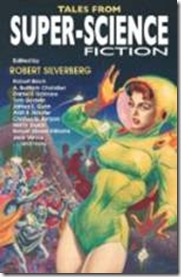
Book Review Tales from Super-Science Fiction by Robert Silverberg (Editor)

Tales from Super-Science Fiction
Robert Silverberg (Editor)
Haffner Press
Publication Date: May 28, 2012
Trade Paperback (ARC)
400 pages
ISBN13: 978-1893887480
Cover art by Frank Kelly Freas and Ed Emshwiller

clip_image002

     Tales From Super-Science Fiction was a short-lived popular men’s magazine published between December 1955 and October 1959 and featured stories written by some of the most well-known names in Science Fiction, including Isaac Asimov, Robert Bloch, Harlan Ellison, James E. Gunn, Robert Silverberg, Jack Vance, and Donald Westlake, among others. It’s short life, only 18 issues, reflected the changing trends in pulp literature during a period when no less than fifty different men’s magazines published stories from genres as diverse as adventure, noir, mystery, sex, horror, fantasy, and science fiction. With names like Men’s Life, Stag, True War, and Real Men the Science Fiction pulps, like Tales From Super-Science Fiction, were created to cater to the tastes of men who enjoyed stories about space exploration, strange new worlds, ray-guns, and alien monsters.

     One of the difficulties reviewing and rating an anthology of fifty-year-old stories is that there are a number of stumbling blocks that need to be overcome to provide a meaningful review. The fourteen stories collected from Tales From Super-Science Fiction provide an eclectic representation of the pulp Science Fiction short-stories written during the late-fifties, so there’s really nothing new here. However, it should be noted that, at the time, similar stories were in high demand and many Science Fiction, Horror, Adventure, and Western pulps were published to fill a niche for men’s fiction. This anthology contains stories by known and established Science Fiction authors, many of whom have, sadly, passed. It is important to remember that several of these same authors wrote some of the most entertaining Science Fiction novels of the sixties and seventies (Asimov’s Foundation Series (1966 Hugo Winner) and Fantastic Voyage; Ellison’s A Boy and His Dog; Vance’s The Dragon Masters (1963 Hugo Winner); and Silverberg’s Thorns (1967 Hugo and 1968 Nebula nominated), to name a few.) Tales From Super-Science Fiction was not the most popular Science Fiction magazine of the times and the majority of the author’s represented here admit to cranking out voluminous stacks of short fiction simply to pay the bills. And, Tales From Super-Science Fiction paid double (2 cents per word!) the average going rate at that time. These early practitioners obviously loved writing their stories and they’d be the first tell you today that they had a great deal of fun exploring the genre and submitting their stories for publication while getting paid so handsomely. The Introduction by Robert Silverberg is an important, historic snap-shot of the mentality and publishing accounts of the magazine and its editor, Scott Harlan, and is worth the cover price simply for its historical significance. In my opinion, it’s important that these stories were assembled and published in anthology format, if nothing more than for the sake of preservation. Obviously, fifty-year-old space-monster stories will not appeal to everyone but it should be known that they helped pave the way for many of the popular monster (read vampire/ werewolf/ supernatural) stories that are wildly popular today.

     So, how does one go about reviewing an omnibus of older stories? Should Tales of Super-Science Fiction be reviewed and rated individually by story or as a single anthology of short stories? Hard call, that. Should the book be rated by the significance of the stories in their respective place in history or by more contemporary standards? Should it be reviewed based on the quality (or lack thereof) of the stories which were admittedly written for the quick cash to meet the rent each month?

     In the end I decided to review the book as a single entity keeping in mind the times and circumstances in which the individual stories were written and published. To do otherwise would be unfair to the authors and to the genre as it existed then. Adventure, war, mystery, westerns, space exploration, monsters, and aliens were the subjects that interested men in the late-fifties and were tremendously popular. (Things really haven’t changed that much, have they?) Tales From Super-Science Fiction was published a decade after the Golden Age of Science Fiction and the close of the Second World War to fill the burgeoning need for stories of the fantastic. Technology was beginning to bloom in unexpected ways in the United States and newly imagined gadgets and the race for dominance in space began fueling many of the stories found within the pages of men’s magazines. That the themes and memes found in these stories were not new or inventive, even in the late-fifties, really doesn’t matter all that much. What’s meaningful is that the writers understood their audience and provided exactly what they asked for, frequently in record time. That the stories themselves were sometimes silly, occasionally illogical, and often far-fetched means very little. To me Tales From Super-Science Fiction and it’s stories represent a microcosm of the American Dream. The writers developed a product, marketed it, sold it, were asked for more, and delivered in kind.

Table of Contents

Introduction by Robert Silverberg

"Catch 'Em All Alive" by Robert Silverberg

"Who Am I?" by Henry Slesar

"Every Day is Christmas" by James E. Gunn

"I'll Take Over" by A.Bertram Chandler

"Song of the Axe" by Don Berry

"Broomstick Ride" by Robert Bloch

"Worlds of Origin" by Jack Vance

"The Tool of Creation" by J.F. Bone

"I Want to Go Home" by Robert Moore Williams

"Hostile Life-Form" by Daniel L. Galouye

"The Gift of Numbers" by Alan E. Nourse

"First Man in a Satellite" by Charles W. Runyon

"A Place Beyond the Stars" by Tom Godwin

"The Loathsome Beasts" by Dan Malcolm (aka Silverberg)

     File with: Classic Science Fiction, aliens, monsters, pulp fiction, adventure, and space exploration and exploitation.

3 ½ out of 5 stars

The Alternative
Southeast Wisconsin

Additional Reading:

 Tales From Super-Science Fiction Haffner Press Page

Tales From Super-Science Fiction Amazon Page

Quasi-Official Robert Silverberg Website

Robert Silverberg Wiki Page

Free (and Legal) Short Story Downloads from the Guttenberg Project:

Robert Silverberg

Henry Slesar

James E. Gunn

Don Berry

Robert Bloch

Jack Vance

J. F. Bone

Robert Moore Williams

Tom Godwin

Monday, April 30, 2012

Book Review - Starters by Lissa Price

Starters
Lissa Price
Trade Paperback (ARC)
352 pages
Publisher: Delacorte Books for Young Readers
Publication Date: March 13, 2012
ISBN-13: 978-0385742375

clip_image002

     I must admit a fondness for Science Fiction that builds on unique twists or creative concepts. Works that include highly imaginative or original plots, characters, or settings always seem to capture my attention. In fact, I’m going to confess publically that I’ve often rated books slightly higher than I might otherwise simply based on what I think is unique or inventive content. And, as long as I’m in full confessional mode I might as well come clean that Young Adult Science Fiction and Fantasy is often as entertaining and appealing to me as so-called “mature” SF&F. This might explain my admiration for the Harry Potter, Lord of the Rings, His Dark Materials, and Ender franchise’s or anything written by Diana Wynne Jones, for that matter. But, I digress.

     Starters, by Lissa Price, is a singular case in point. It is, overall, an excellent debut novel, written in a strong voice and with unabashed confidence and, oh, by the way, has killer cover art. But, I have a dilemma and I have to ask myself a few pointed questions before moving forward with this review. How exactly do I classify “unique” or “creative”? Should that definition be based on my own past reading experiences? Or by what I know has been previously published though I haven’t actually read it myself? Is this work merely “somewhat” original, a play on an existing theme, for instance, or is it a mind-blowing never-before-seen idea?

     Let’s start with the basic premise of Starters. A biological war kills everyone between the ages of 20 and 60. Okay, slightly unusual in post-apocalyptic concept since most fictional “world-killing” events are normally not that selective and real-world pandemics do just the opposite. So, points to Ms. Price for thinking, not just outside, but around the corners of the box. Body swapping and/or using others to remotely experience the actions of others is a major theme in Starters, but this same idea has been used successfully many times before. The Identity Matrix by Jack L. Chalker and I Will Fear No Evil by Robert A. Heinlein, among others, contain similar themes. Credit to Ms. Price for the unusual manner in which the Enders “use” young bodies. Dystopian future filled with struggling survivors? There are too many similar works to name here. Unsupervised children in a post-apocalyptic landscape? Dhalgren by Samuel R. Delaney and The Wild Shore by Kim Stanley Robinson spring to mind.

     So, what’s the dilemma? Good question. While most of the concepts in Starters have already been written in one form or another and by established, respected authors there is something solely “different” about this work of fiction. In short, Starters has a fresh and highly creative “feel” about it. So, when a debut novelist delivers a story that comes off as completely new, even though it utilizes “been-there” concepts, I have to step back and evaluate my opinion and why I feel the way that I do about it. So, how do I rate it?

     Let’s take a quick look at the positive aspects first. There’s a certain level of genre blending in Starters that Ms. Price handles both efficiently and effortlessly and that appeals to me as a reader, a lot. The story feels, at times, Urban Fantasy, like when the characters are squatting in an abandoned high-rise or running from bullies, then changes to Cyberpunk during the nuero-implant and body-swapping scenes, and then becomes Post-Apocalyptic when the death’s of millions and the resulting societal alterations are described. And for those looking for that Twilight or Hunger Games connection there’s also an understated young-love story swirling about. Each genre switch is handled without stumbling over the others and is competently written, the transitions so smooth they’re hardly noticeable.

     The main character, Callie Woodland, has a lot to do with why I feel this book is such a worthwhile read. She is a survivor - cautious, imaginative, courageous, and street-smart, yet, at the same time believable and utterly likeable, like your kid-sister or a favorite cousin. Again, we’ve all come across protagonists like this before but Ms. Price’s dialogue, timing, and the emotional voices of the main and supporting characters are intuitive and entirely believable.

     There are a lot of reasons I think Starters feels so original and refreshing and why I believe it deserves a huge audience. For instance, Callie’s love for her little brother and the sacrifices she’ll endure to make a better future for him is heartwarming, touching, and wholly convincing. Also, the Starters make up the poverty-stricken lower class while the Enders are, for the most part, prosperous and upper class. This is a unique enough shift in social inequality to merit mentioning. Not that teenagers haven’t always suffered as less-than-equal but it’s the way Ms. Price handles this theme that impresses me. When Starters rent their bodies to Enders so that they can experience, via neuro-implant, what it’s like to be young again the story really becomes interesting. And, what the Ender’s do with those bodies while the hosts are “under” could easily be considered unethical or immoral. The idea of a young person’s body possessed by the psyche of an Ender is often disturbing but very entertaining. Is the person I am interacting with at this moment a true Starter or, is an Ender in someone else’s body controlling them? Taken as a whole there are enough new and creative ideas intermixed throughout this story to rate it fairly high. So, I will.

     With that said, Starters is not without minor problems. A few insignificant plot holes and descriptive issues appear now and then, but the story moves at such a pace as to render them somewhat transparent. Keeping in mind that Starters is Lissa Price’s debut novel I think it safe to say that her narrative prowess will mature and, in the process, she will learn to eliminate the pitfalls of those minor inconsistencies. I can’t wait to see what Ms. Price has in store for us in the continuing stories of the Unseen Saga.

     Recommended for young adults, dystopian fans, those interested in body swapping, mind control, and the ramifications of eternal youth. Also, well-suited for mystery lovers, suspense enthusiasts, urban fantasy fanatics, and post-apocalyptic literature fans. And, there’s a subtle, well-written YA first-love story circulating throughout the book that should appeal to those who enjoy a little romance mixed in with their Speculative Fiction.

     File with: Fiction - Most of the works of Jack L. Chalker, Total Recall by Philip K. Dick, I Will Fear No Evil by Robert A. Heinlein, The Annals of the Heechee by Frederik Pohl, Software by Rudy Rucker, Nueromancer by William Gibson, Time Enough for Love by Robert A Heinlein, and Old Man's War by John Scalzi. TV and Film - Caprica, Dollhouse, and Avatar.

4 out of 5 stars

The Alternative
Southeast Wisconsin


Additional Reading:

Starters Webpage

Starters Amazon Page

LA Times Starter Review

Official Random House Starters Page

Random House Starters Series Page

Portrait of a Starter Amazon Page

Unseen Series
00. Portrait of a Starter (e-story prequel) 2012
01. Starters 2012
02. 2nd Unhidden Story (e-story) 2012
03. 3rd Unhidden Story (e-story) 2012
04. Enders 2012

Wednesday, April 18, 2012

Book Review - The Road of Danger by David Drake

The Road of Danger
Republic of Cinnabar Navy (Lt. Leary) Book Nine
David Drake
Trade Paperback
(Advance Reader’s Copy)
Publisher: Baen
Publication Date: April 3, 2012
368 pages
ISBN-13: 978-1451638158
Cover Art: Steve Hickman

clip_image001

     In the grand tradition of Golden Age Space Opera, The Road of Danger, the ninth in the Republic of Cinnabar Navy series, is an exemplary example of the genre. The series has, and rightly so, been compared to the high-seas adventures of Horatio Hornblower by C. S. Forester and the Aubrey-Maturin series by Patrick O’Brian. Except, and this is really important so listen closely, the RCN (or Lt. Leary) books are much, much better. Yes, I said it, and I’ll probably hear all sorts of flack since both Forester and O’Brian are much beloved authors. But, hear me out. They didn’t write Science Fiction Space Opera. And, the RCN books have something you’ll not find anywhere in those classics - space ships, FTL sub-lightspeed travel, and plasma ray guns. If you’ve read any of my previous reviews you’d know by the content that I’m a long-time Science Fiction fan. So, it should come as no surprise that I place the RCN series higher than those set on the high seas. (My apologies to Forester and O’Brian fans.)

     With that said, I think that Mr. Drake has an exceptional eye for developing atypical and fascinating personalities. The two main characters, Daniel Leary and Adele Mundy, are no exception and happen to work together like a well-oiled space-cruiser. Leary is a brilliant strategist, a charismatic, successful naval officer with a professional hit-man’s instincts and has an even-tempered nature even in the face of adversity. Mundy, the intelligence officer, is a self-professed information hound, is composed even under duress, has a no-nonsense attitude, and is especially competent with fire-arms. She isn’t afraid to shoot it out if the situation calls for it either. The minor characters stand out, as well. Lieutenant Vesey of the fighting corvette Princess Cecile is an able sailor who keeps her composure even during intense situations. And Leary’s and Mundy’s retainers, the sociopathic Hogg and Tovera, provide deadly, yet somehow comic relief.

     Ordered to a normally peaceful sector of the galaxy to  quell a minor coup and repatriate the ringleader Leary and Mundy get caught up in local politics. But life as an officer in the RCN is rarely static and they quickly discover that the rebellion is backed by a syndicate of warring merchants on a nearby world where commerce rules, profits are high, and business is conducted with coercion and by armed conflict. The situation is made worse when a rogue Alliance intelligence officer plots to rekindle the Alliance-Cinnabar war for his own gain. Leary, Mundy, and their team must find a way stop the rebellion, capture the recreant officer, and bring peace back to the sector.

     All in all, The Road of Danger is, in my opinion, not the best of the nine stand-alone RCN books (Lt. Leary, Commanding is my favorite.) It is, nevertheless, a solid and entertaining addition to this fast-paced, adventure series. More importantly, it was as much fun to read as the others.

     Recommended for Science Fiction Space Opera fans, military fiction enthusiasts, action-adventure buffs, political intrigue lovers, space gadget geeks, war/combat/strategy fanatics, and those who love a dose of solid throw-back Science Fiction.

     File with: The Lensman Series by E.E. “Doc” Smith; the Captain Future books by Edmond Hamilton, the Known Space works of Larry Niven; Star Wars; the Culture books by Iain M. Banks, Allen Steele’s Coyote series, and, my current favorite, Jack McDevitt’s Alex Benedict series.

4 out of 5 stars

The Alternative
Southeast Wisconsin

Additional Reading:

David Drake Official Site

RCN Wiki Page (Free Downloads)

With the Lightnings Free Download

Space Opera Wiki Page

Republic of Cinnabar Navy (Lt. Leary) Series

1. With the Lightnings (1998)
2. Lt. Leary, Commanding (2000)
3. The Far Side of The Stars (2003)
4. The Way to Glory (2005)
5. Some Golden Harbor (2006)
6. When the Tide Rises (2008)
7. In the Stormy Red Sky (2009)
8. What Distant Deeps (2010)
9. The Road of Danger (2012)

Sunday, April 15, 2012

Book Review - Against the Light by Dave Duncan

Against the Light
Dave Duncan
Trade Paperback
(Advance Reader’s Copy)
Publisher: 47North
Publication Date: January 24, 2012
484 pages
ISBN-13: 978-1612182032

clip_image001

     Well-written action-packed high fantasy is obviously Dave Duncan’s forte and he delivers a solid narrative once again with Against the Light. Best known for his Seventh Sword and King’s Blade fantasy series Duncan never fails to entertain with his complex, character driven stories. In my opinion, Mr. Duncan is one of the better fantasy writers of our time. The highest praise that I might give a fantasy writer is that their work reads “real-world.” By that I mean that the story itself feels like it could have actually happened. In Against the Light there are obvious connections to true historical events, most notably the social and political ramifications and religious persecutions of the Middle Ages, and that alone is enough to make it seem real-world.

     While Mr. Duncan normally develops his characters with great success the characters in Against the Light are not quite as strong as those in his other books. His characters are not as highly-developed, or completely likeable (or hate-able, if that’s a word), nor as memorable as those in previous works. And, the graphic torture scenes may be a little too intense for some readers. They made me feel a little uneasy, and I’m far from squeamish, but perhaps that’s because of the lengthy exposition Duncan gave them.

     In Against the Light the high priests of Albi hold sway over the powers of religion and magic, a deadly combination to be sure. Followers of the old ways are persecuted as heretics and when Rollo Woodbridge is arrested for heresy the entire kingdom is pushed to the brink of chaos. The arrest affects the entire Woodbridge family and culminates in the destruction of the family home and the deaths of family members. While Rollo’s sister Maddy positions herself socially and politically to avenge the loss, his brother Brat joins the underground resistance, and Rollo works frantically to find a way to save the kingdom and, in the process, the remaining members of his family.

     While I understand that this type of fantasy – persecution/vengeance – has been done before Duncan’s unique voice, character-driven plots, and real-world correlations make all of his stories stand out in the genre. This is definitely not his strongest story but still entertaining and worth the time, especially if fantasy is “your thing.”

     Recommended for fans of high-fantasy, underground movements, action/adventure/suspense, and those interested in well-written character driven stories.

     File with: Katherine Kurtz’s Deryni Series, Raymond Feist’s Riftwar books

3 ½ stars out of 5

The Alternative
Southeast Wisconsin

Additional Reading:

Dave Duncan Official Author Site

Against the Light Sample Chapter

Against the Light Amazon Page

Saturday, April 07, 2012

Breaking news…

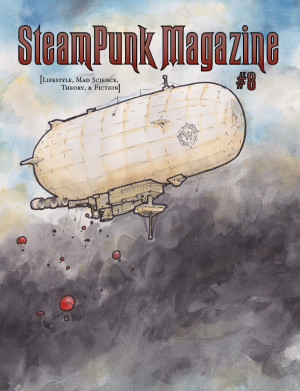
     The Alternative is now a contributing reviewer for SteamPunk Magazine. Check out their website, become a subscriber, download back issues, and look for Issue # 9 in early fall of 2012.

SteamPunk Magazine

Issue #8

SteamPunk Magazine Download Page

SteamPunk Magazine Back Issues

Note: Reviewing for SteamPunk Magazine will NOT interfere with normal posts to this site. In fact, I expect it to enhance The Alternative blog in the near future.

Thursday, April 05, 2012

Book Review – Exogene by T C McCarthy

Exogene
Subterrene War Series Book Two
T. C. McCarthy
Orbit Books
Publication Date: March 1, 2012
Mass Market Paperback
400 pages
ISBN-13: 9780316128155
Cover Art by Steve Stone

clip_image002

     SWFLMGELE18

     Talk about alternative life styles? Single, white, female, lesbian, military, genetically-enhanced, life expectancy 18 years. Yes, you read that right, that’s the social status of the main characters in T. C. McCarthy’s Exogene, the second book in the Subterrene War series. Following Germline (see my review here), the first book in the series, we enter back into an alternate universe that is running low on natural resources and ravaged by conflict. Rare and precious metals are so expensive, so integral to technology, and so isolated by location that they are worth going to war over. However, rather than seen through the eyes of a civilian, as in Germline, we track the exploits of the genetically-enhanced female soldiers that are, in essence, disposable. Programmed to “spoil” at the tender age of eighteen these soldiers are lethal killing machines but the government does not want them walking around free after they’ve out-lived their usefulness. The answer? Get rid of them after two years of service by programming them to “self-destruct” or “spoil” starting on their eighteenth birthday.

    McCarthy’s main character in Exogene is Catherine, one of the genetically-engineered 18-year-old killing machines. While she’s an effective soldier and dreams of dying to reach paradise and meet God she’s having doubts about spending the rest of her life as a soldier and giving herself up at the end of her service. Catherine has heard rumblings that a sanctuary for over-aged soldiers can be found in Thailand and she’ll do almost anything to get there.

    It’s not often that Science Fiction represents strong (read kick-ass) women as main characters but T.C. McCarthy does that and more. The subtleness of being a soldier and a woman is captured beautifully but to do so in the midst of a long-running war even more so. While some may consider this series military science fiction I think it falls more into the realm of social science fiction. Are genetically-engineered beings truly human? What might they do to be “considered” equal? What are the future implications of tampering with genetic material? McCarthy displays great skill in imagining a world history that, given the right circumstance, could very well come to be. Assuming the voice of his characters McCarthy comments on what it means to be human and the means those considered “less than” might attempt to attain equality. Tucked unobtrusively into a science fiction novel is a vast commentary on our future. Genetic manipulation, forced euthanasia, social inequality, and the human condition all play their parts in this story which McCarthy handles with his usual, seemingly effortless approach.

    The third book in the series, Chimera, is due out later this summer. I can’t wait to see how he wraps up the series.

    Recommended if you like anything by Joe Haldeman, David Gunn’s Death Head series, or Robert Buettner’s Jason Wander series or if you’re a fan of military science fiction, social science fiction, future warfare, quests, technological advances, genetic manipulation, resource depletion, or solid, creative, thought-provoking fiction.

4 out of 5 Stars

The Alternative
Southeast Wisconsin

Additional Reading:

T.C. McCarthy Author Page

Exogene Page

Exogene Amazon.com Page

Exogene Cover Page

Subterrene War Series
1. Germline (2011)
2. Exogene (2012)
3. Chimera (2012)

Monday, April 02, 2012

Book Review - The Burning Sky by Joseph Robert Lewis

The Burning Sky
Halcyon Series Book One
Joseph Robert Lewis
Publication Date: December 2011
Self-Published
ASIN: B004MDLL9K
eBook Edition
462 pages (Portrait View)
Cover Art by Max Davenport

clip_image001

     Ah, more Steampunk! The Burning Sky, the first in the Halcyon Series, by Joseph Patrick Lewis is loaded with Steampunk, magic, dirigibles, political intrigue, angelic ghosts, subtle magic, saber-tooth tigers, nine-foot raptors, shoot-outs, cold-blooded murders, and sword-fights all wrapped up into one remarkable Urban Fantasy set on an alternate Earth. What could be better than that? How about all of the above, superbly written, tightly woven, and packed full of action scenes.

     The Burning Sky is quality writing with great characters, an interesting mystery, a cunning antagonist, and a number of unusual but compelling protagonists whose motives, although somewhat hazy to start, soon become clear as the story develops. By far the most interesting character is Syfax Zidane, an ex-soldier and Major in the Royal Marshals. Syfax is a policeman that shoots first and doesn’t need to ask questions later. He’s been passed-over for promotion due to his “wild” antics and the number of dead criminals he’s arrested but he doesn’t seem to mind. He’s loyal, smart, and driven and certainly knows what’s right and he’ll do anything to make sure that good has a champion, even if a few criminals get hurt in the process. He’s in hot pursuit of an arsonist and murderer and is not afraid to employ any method necessary to secure an arrest.

     Other characters worth mentioning are the conniving Ambassador Barika Chou; Shifrah, a paid assassin; Qhora Yupanqui, an Inca princess and her husband Don Lorenzo Quesada de Gadir; and Taziri Ohana an electrical engineer and the pilot of the dirigible Halcyon. de Gadir is a swordsman of some renown and can talk to a ghost and Qhora keeps a nine-foot tall domesticated bird and a saber-tooth tiger as weapons of war. Ambassador Chou has a political axe to grind and will do anything to promote her cause, including murder. Taziri Ohana is caught in the middle of it but all she wants is get back home. If that isn’t enough to get your creative reading interest flowing then nothing will.

     One of the more unique and unusual elements Mr. Lewis has employed in his alternate universe is the integration of Steampunk with the dawning of the age of electricity. Scientists and engineers are becoming more prevalent and certain high-ranking government officials have begun to manipulate science to their benefit. But to what ends? Modern electricity is wholly regarded as an impingement on the current way of life and it plays a subtle but integral role in the plot. Its very existence could bring the world to the brink of war. In many ways The Burning Sky transcends Steampunk as it draws from elements of the advent of the Industrial Age, noir suspense, clever mysteries, sword-flashing fantasy, and plenty of action adventure.

     A short word about self-publishing and why I think it’s a good thing. There’s a lot of debate both for and against self-publishing these days, mostly concerning quality, and the perspective depends on which side of the fence you’re on but in my modest opinion if there ever was a good argument for self-publishing then The Burning Sky is definitely it. As a matter of fact, if you ever find yourself in a dispute with a purist, or his agent, put a copy of this book into his hands. Argument instantly over! This story is polished and professional and as well-crafted, edited, and written as anything that comes out of the established houses. If this is a glimpse of the future of publishing then we, as readers, are in for a very fun ride.

     If you liked Chris Wooding’s Ketty Jay series, Cherie Priest’s Clockwork Century cycle, or Mark Hodder’s Burton & Swinburne books then the Halcyon series is ideal for you. Also, recommended for Steampunk fans, Science Fiction and Fantasy buffs of all kinds, those who enjoy an action-packed swashbuckling adventure, anyone who takes pleasure in strong character-driven stories, mystery aficionados, suspense junkies, and anyone looking for something truly unique to devour.

4 ½ out of 5 stars

The Alternative
Southeast Wisconsin

Halcyon Series

(Part of The Other Earth series of books)

1. The Burning Sky (February 2011)
2. The Broken Sword (May 2011)
3. The Bound Soul (August 2011)

clip_image003

Other Books by Robert Joseph Lewis:

Europa Series
1. Omar The Immortal
2. Freya The Huntress
3. Wren The Fox Witch

Chimera Duet
1. The Dragon and the Lotus
2. (Coming Soon)

Other Books:

Heirs of Mars: Prelude

Heirs of Mars

Daphne and the Silver Ash

Additional Reading:

Author Website

Author’s Blog

Joseph Robert Lewis Digital Publishing Article

Amazon.com The Burning Sky Page

Amazon.com The Broken Sword Page

Amazon.com The Bound Soul Page

More on the authors mentioned in this review and Steampunk in general:

Chris Wooding

Cherie Priest

Mark Hodder

All things Steampunk

The Steampunk Workshop

Steampunk Magazine

Comprehensive List of Steampunk Works

Steampunk Music

Wednesday, March 28, 2012

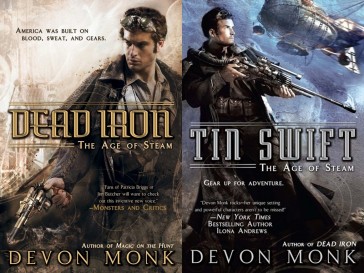
Book Review - Dead Iron by Devon Monk

Dead Iron
The Age of Steam Series Book One
Devon Monk
Roc Trade
Publication Date: July 5, 2011
Trade Paperback
352 pages

clip_image002

     Ask any writer, editor, or publisher the one thing they think makes or breaks a good book and nine times out of ten they’ll reply, “The first sentence has to grab you, pull you in, get you invested in the character or the setting or some other aspect of the story. Otherwise, you’ll lose the reader’s interest.” Devon Monk’s Dead Iron: The Age of Steam does just that. As a matter of fact, the first sentence tells a story in itself.

     “Cedar had stared straight into the killing eyes of rabid wolves, hungry bears, and charging bull elk, but Mrs. Horace Small had them all topped.”

     I wouldn’t call this the best first line that I’ve ever read but it certainly does what every good opening sentence is supposed to do. It pulls you in and you want to learn more about the characters, want to see what happens next and once you start reading you’ll find it difficult to put down.

     Cedar Hunt is a frontiersman with a secretive past living in a cabin near the remote village of Hallelujah and that gives him the perfect opportunity to steer clear of other folks. But when supplies run low Cedar must travel into town to replenish them. While in the general store Cedar learns that a four-year-old child has disappeared under mysterious circumstances and he takes it upon himself to track him, find the abductor, and bring them both back dead or alive. His resolve is cemented when he discovers that the mysterious “Strange” is somehow involved in the disappearance. Rose Small is an enigma in town. She’s beautiful but unmarried and at seventeen that’s unusual for these parts. But Rose has a penchant for strange, little “devices” and most town-folk regard her as slightly touched in the head. Rose is unaware that she also harbors a long-lost secret. When Mae Lindsom “feels” her husband’s death the ties that once bound them together are instantly severed. In that moment the call from her coven to return home becomes too strong to resist. But first, she must find a way to destroy her husband’s killer. The antagonist, Shard LeFel, is as slimy as Simon Legree, more cold-hearted than the Grinch, and as vindictive and downright mean as Lemony Snicket’s Count Olaf, and he has something to hide as well. To make matters worse, he’s killed Mae’s husband three times! Busy bringing the railroad through Hallelujah LeFel is in exile looking for a way back to his homeland which, we sense, isn’t even in our universe. The bizarre Madder brothers seem to enter and leave the story at timely, or depending on your perspective untimely, moments and we’re never quite sure of their motives. They’re protecting something. But what? Very early on in the narrative it becomes apparent that time is running out for every one of them.

     In my opinion, Dead Iron should be classified in a genre of its own. With elements of Steampunk, the frontier old west, dark magic, the mysterious “Strange,” lycanthropic heroes, bogeymen, steam-powered “devices” and a surplus of oddball characters, this story seems to reside outside any one genre but pulls in elements from many. I thought to call it “Strange”punk but that sounds awkward and Metalpunk sounds too much like a music genre. SteamWest doesn’t fit well, either. Magicpunk? No. Frontierpunk? Westernpunk? Devicepunk? No, no, and no. But somehow all of them fit in some way.

     If you visit Ms. Monk’s author site you’ll see that at least one other book is scheduled for the series (Tin Swift 2012) and that’s a good thing because I, for one, want to know more about all the characters she’s so skillfully crafted. In a perfect world this would be a series that enjoys a long run and sells tons of copies. I know I’ll be contributing to making the world a little less imperfect by purchasing the future books in the series.

     Dead Iron: The Age of Steam is well-written, fast paced, has a unique and creative premise and is thoroughly enjoyable and entertaining. Recommended if you liked Mike Resnick’s The Buntline Special, Joe R. Lansdale’s Dead in the West, or Cherie Priest’s Boneshaker and best suited for western lovers, Steampunk fans, urban fantasy and magic enthusiasts, and those who simply love to enjoy an engaging read.

4 ½ out of 5 stars

The Alternative
Southeast Wisconsin

Additional Reading:

Official Author Site

Devon Monk Wiki Page

Dead Iron: The Age of Steam Excerpt

Dead Iron: The Age of Steam Amazon.com Page

“The Ranting Dragon” Book Review

The Age of Steam Series

1. Dead Iron (2011)
2. Tin Swift (Scheduled July 3, 2012)

clip_image004

Tuesday, March 20, 2012

Book Review – Assassin’s Code (Joe Ledger 04) by Jonathan Maberry

Assassin’s Code
Joe Ledger Series Book Four
Jonathan Maberry
Trade Paperback (Advance Reader’s Copy)
Publisher: St. Martin's Griffin
Publication date: April 10, 2012
ISBN-13: 978-0312552206
432 pages

image

     Sometimes you can judge a book by its cover.

     I requested Assassins Code from a group of Advance Reader’s Copies simply because the cover intrigued me. I know, I know, “looks can be deceiving” and “you can’t judge a book by its cover” but in this case I wasn’t disappointed. I have to confess that I've never read any of the other books in the Joe Ledger series and starting with the fourth book is probably not the best way to be introduced to a series but there was absolutely no disconnect in the story for me and I was able to follow it easily without having any of the back story of the first three books. The first compact chapter, only 48 words long, hooked me immediately and the story only got better from there. After reading Assassin’s Code I will definitely pick up the other titles in the series. I admit to having an affinity towards techno-thrillers with strong characters (i.e. Steve Berry’s Cotton Malone series) and Assassin’s Code fits into that mold nicely.

     In some ways Joe Ledger reminds me a bit of Cotton Malone, Mac Bolan, and Doc Savage all mixed into one character. All are, or were, government contract operatives, are tough, witty, and sarcastic and their exploits are packed full of action scenes. The only real difference between them is that Joe Ledger is an extremely funny character. No, I take that back. What Joe Ledger thinks and says is often times hilarious. The novels are similar in some respects, as well. The plots are always eventful and conclude effectively and the suspense leading up to the climax is always “edge of the seat” and full of entertaining twists and turns.

     In Assassin’s Code, Joe Ledger and his team are tasked with extricating three American’s from an Iranian prison after they are taken into custody on accusations of spying. In the process, Joe meets a member of the Iranian government that tells him seven black-market Russian nuclear bombs are in the hands of terrorists and that their mere presence threatens both countries. Ledger and his team need to find them and quickly. Mixed into that story line is a clandestine society bent on keeping their secrets hidden and destroying their enemies, namely anyone associated with Ledger and his team. The premise, “the enemy of my enemy is my friend” while cliché in some respects, stands up well under the hand of Jonathan Maberry who weaves as suspenseful and thrilling a tale as I’ve read in a very long time.

     Recommended for thriller/suspense buffs, fans of military fiction, enthusiast of character driven suspense, and anyone that enjoys secret government operatives, spies, political intrigue, and secret societies peppered throughout a solid fictional drama.

4 out of 5 stars

The Alternative
Southeast Wisconsin

Additional Reading:

Assassin’s Code Amazon.com Page

Assassin’s Code Excerpt

Fan Based Joe Ledger Page

Jonathan Maberry’s Big, Scary Blog

Jonathan Maberry Wiki Page

Jonathan Maberry Interview

The Joe Ledger Series
1. Patient Zero (2009)
2. The Dragon Factory (2010)
3. The King of Plagues (2011)
4. Assassin's Code (2012)

Sunday, March 18, 2012

Book Review (Poetry) - The Mexican Saga: A Journey Through the 20-Count by Elaine Stirling

Elaine Stirling
The Mexican Saga: A Journey Through the 20-Count
Greyhart Press
Publication Date: December 2011
eBook Edition
42 Pages (portrait view)

clip_image001

     Profoundly influenced by Carlos Castaneda’s Teachings of Don Juan and the collapse of civilization predicted to occur at the end of the Mayan calendar, The Mexican Saga: A Journey Through the 20-Count by Elaine Stirling is a snap-shot reflection of the life of an extraordinarily gifted child as her life-journey takes her from shaman initiate to full Nagual (shape-shifter.) This is a rare, though brief, look into what it may have been like to be a member of the Toltec community and is a true coming of age prose-narrative written from inside a culture that was truly ahead of its time. I’ve always believed that this variety of poetry is one of the most complicated to create but, it is also the most rewarding for the reader, especially if the subject matter is of interest. Thematic poetry can be complex and is often difficult to maintain but Stirling has created an inspiring epic in less than fifty pages. If only every poet could be that succinct. In my opinion, no poetry is ever perfect. Even in the mind of the creator it is ever- evolving, always changing but Elaine Stirling’s voice, rhythm and word choice demonstrates that she is passionate about the subject, has studied it thoroughly, and easily provokes in the reader the unique emotional responses intended. And, that’s what all good poetry is supposed to do.

     In The Mexican Saga Elaine Stirling has created prose-verse that blends ancient Toltec with contemporary Mexico and manages to successfully provoke considerable thought and image employing a compact and concise approach. She becomes the voice of an Indio shaman and her readers willing pupils. Mix two parts early spirituality, one part supernatural, and one part key, elegant phrasing and you’ll begin to appreciate the subtle nuances of The Mexican Saga. But this is not a re-telling in prose of the ideals and leanings of Castaneda or Don Juan. Rather, Ms. Stirling brings distinctive, creative, and clever ideas of her own to the table that draw you back to old Mexico where you can taste the flavors, hear the sounds, and experience the life of the high-desert philosophy as she traces the life of an emergent initiate. The only real complaint I have about this tightly woven book of poetry is that it was over well before I wanted it to.

My favorite passage:
"You own only two things in life:
Your death, he held up one finger,
Spooled around me,
And perception, held up another."

     Recommended for poetry lovers, anyone interested in shamanism, those attracted to the works of Carlos Castaneda, anybody mystified or fascinated by the Mayan calendar or the Toltec culture, and those who truly appreciate exceptional thematic poetry.

4 out of 5 stars

The Alternative
Southeast Wisconsin

Additional Reading:

Greyhart Press site

Elaine Stirling Site

Amazon.com site

The Mexican Saga

Nagual Wiki Page

Toltec Culture Wiki Page


clip_image003