Sunday, January 27, 2013

Book Review - Apocalypse Z: The Beginning of the End by Manel Loureiro

Apocalypse Z: The Beginning of the End
Manel Loureiro
Trade Paperback
333 pages
Publisher: AmazonCrossing
Publication Date: October 23, 2012
ISBN-13: 978-1612184340
Advance Reader’s Copy – Uncorrected Proof

clip_image002

     More zombie goodness…

     Normally I keep extensive notes when reading so that I can use those notes to develop my review of the book based on my “in-read” impressions. In the case of Manel Loureiro’s Apocalypse Z: The Beginning of the End there just wasn’t time. I became so engrossed in the story, so entertained, that I neglected (plain forgot) to keep a single note on the story. Here’s why that’s a good thing: 1) The story grabs you from the start and doesn’t let go until the last word. 2) In a word, Realism – The story, characters, and scenes are very realistic in every sense of the word. Yes, we are talking about zombies here but insert “ambulatory plague victim” and it still works on every level. 3) Very Fast Read – Apocalypse Z is an extremely fast paced story and therefore a very quick read. I think I read it in just under eight hours. 4) Settings – All the action is set in Spain and on boats off the coast and that lends an unusual European feel to the zombie situation. I thoroughly enjoyed the locales that were so very different than those found in most of the zombie stories I’ve read. 5) Zombies – It’s another freaking zombie story! (Period.) 6) The main character could be you or I – Mr. Loureiro’s zombie apocalypse survivor is an everyman. Not a hero, not a macho, over-the-top caricature of a survivor but the embodiment of the normal man attempting to survive in a harsh and dangerous environment. He makes mistakes and he pays for those mistakes and that’s what makes this character and the entire story so compelling.

      The book begins as a blog from a lonely man in Spain who’s just recently lost his wife and is looking for something to keep his mind occupied. But some very strange stories are coming out of Russia. Little by little the story unfolds that something has escaped a government facility and a pandemic is spreading. What would you do under the circumstances? Where would you go? For one man, the search for a “safe” place is not only a quest but an inward journey for survival.

     If there’s any negative criticism I can make it’s that the story touched very little on the fall of civilization and the wake of societal disorder. Obviously, the story is about the personal journey of one man but by making him a blogger reporting on the fall of mankind I thought the concept could have been better developed and carried through more in the story.

     File with: All the other good zombie books you’ve ever read!

4 out of 5 stars

The Alternative
Southeast Wisconsin

Additional Reading:

Apocalypse Z: The Beginning of the End Amazon Page

Apocalypse Z: The Beginning of the End Audiobook

Manel Loureiro Wiki Page

About The Author: Manel Loureiro (Spain, 1975) has a degree in Law from the University of Santiago de Compostela (Galicia). Combining his studies in this historical city with some television projects, he was an anchorman for various television programs. From writing screenplays he discovered his interest for writing. His first novel Apocalypse Z has been an immediate success and cult phenomenon on the internet. It has had hundreds of thousands of readers worldwide. Apocalypse Z, Dark days, the sequel with the same heroes and their fight to survive in a world dominated by the Undead, has won Manel Loureiro the title of the first author of terror zombie novels set in Spain.

Monday, January 21, 2013

Book Review - Tucker Teaches the Clockies to Copulate by David Erik Nelson

Genre: Steampunk
Title: Tucker Teaches the Clockies to Copulate (Novella)
Author: David Erik Nelson
Publisher/Label: Ars Architeuthis Press; 2 edition (December 30, 2011)
Advance Reader’s Copy – Uncorrected Proof

clip_image002

     I’ve written previously regarding the flexibility of Steampunk in genre fiction and how its themes can appear in almost any type of literature. Tucker Teaches the Clockies to Copulate by David Erik Nelson is a superb example of how Steampunk can be written, and skillfully crafted, I might add, into any category of speculative fiction. It’s not often I’m introduced to a work of fiction that is remarkable in style and content, is exceptionally engrossing, and contains a message. Tucker Teaches the Clockies to Copulate is such a story. In this case, Mr. Nelson has incorporated clock-work men, the American Civil War, sex, alcoholism, humor, an ex-Confederate Soldier, exclusionism, and racism into a condensed novella about mechanical men that have outlived their usefulness as soldiers and make efforts to fit into society. It is Steampunk, to be sure, but above all it is a story that brings to the forefront the principles of equality and the human condition, even if only in emulation. Don’t be fooled by the title, either. While there are elements of the ribald scattered throughout the story what Mr. Nelson shows us is a displaced group of “people,” albeit mechanical, that simply wish to “become” as human as possible. What they’ll do to meet those ends, while comical in execution, is often moving and surprisingly tragic.

     Although Tucker Teaches the Clockies to Copulate contains elements of post-Civil War era living it centers on the displaced nation of mechanical men, known as Clockies, residing near a small, frontier town in Utah. Mr. Kawazoe, the narrator, a Japanese veterinarian (or perhaps, a medical doctor, his profession somewhat ambiguous) is a respected member of the community but still considered untrustworthy and an outsider because of his nationality. He is motivated to spy on Dickie Tucker and his ill-conceived methods of teaching the clockies the fundamentals of frontier life more in the name of science than voyeurism. The story is poignant, human-driven, and well-crafted but the antics of the clockwork men really steal the show. Dickie Tucker teaching clockies to climb a ladder, dance, or make stew is guaranteed to make you chuckle but teaching them farm-related chores has to be the funniest scene I’ve read in a very long time. So much so that I’m obligated to share an excerpt of it.

     “Dickie’s attempts to teach the mechanoman to shoe horses had led to one shod horse, three-quarters of a shod horse (the fourth leg having been broken entirely off; this was swiftly tourniqueted by Sy Everett’s boy, Seth, who happened to be in his father’s neighbors’ barn for purposes never fully explained, and heard the injured animal’s unearthly screeching), four shod cows, a shod sow, and three shod ducks. A similar training session on milking led to 16 gallons of milk (which spoiled well before it was discovered that the clockies had taken the notion to warehouse the milk in the chicken coop), one calloused cow, and one clockie kicked to bits by a bull uninterested in the clockies ministrations to his “single udder.””

     While teaching the Clockies to learn mundane farming skills is fun for the reader it’s when Dickie Tucker teaches the Clockies to copulate that the real story begins and we learn a lesson or two about what it means to be human. Some folks will do almost anything to fit in and the Clockies are no exception.

     It’s not surprising then that Tucker Teaches the Clockies to Copulate was a Nebula Award nominee in 2008 and although he didn’t win, or make the finalists list, he certainly could have. In my opinion, what the world could use more of is additional entertainment like this. I would be remiss if I didn’t say that I feel this story needs to be expanded into an entire world of many Clockie books; the more the better. I hope Mr. Nelson is listening.

     Recommended for Steampunk fanatics, western lovers, those interested in the human endeavor, anyone seeking a story with humor, fans of clock-work men, and those looking to get lost in a compelling story.

5 out of 5 stars

The Alternative
Southeast Wisconsin

Additional Reading:

 Tucker teaches the Clockies to Copulate Amazon Page

David Erik Nelson Official Website

Please note: This review was originally published in Steampunk Magazine January 2013.

Tuesday, January 08, 2013

Book Review - Mark Z. Danielewski - The Fifty Year Sword

The Fifty Year Sword
Mark Z. Danielewski
Hardcover
Pantheon, Random House
285 pages
Genre: Fantasy/Horror
ISBN: 978-0-307-90772-1

clip_image002

     Mark Z. Danielewski does not write novels. He creates experimental visual art that morphs into and weaves through each of his brilliant stories. The playful and unique way he approaches every one of his books is remarkably inventive and what he creates is unlike any other writer working today. His other works, House of Leaves and Only Revolutions, have been characterized as visual writing or Ergodic literature and The Fifty Year Sword is no exception. Yet, if we strip away the word play, the colored words, quotes, and paragraphs, the book flipping, side-bars, stitchery, typography, and marginalia what we find at the core of every one of those books is an entertaining tale. And isn’t that what we, as readers, ultimately crave?

     Experiencing, or participating in, one of his stories (notice I did not say “reading”) is a unique entertainment. This is the third distinctive “piece of art” of his that I've read in the past few years and still, all I can think to say is that this is another totally amazing piece of creative genius. The Fifty Year Sword is not so much a linear novel as a patchwork piece of poetic dialogue that when stitched together creates a dark, unnatural, and malevolent story. Mr. Danielewski plays with words like a master poet and some of his creations are brilliant - "a sudden blue jay avirarity," "gratefullyaccepatating," "consecawence," "sputstuttersobbed," and “s/word.”  These are only a few of the more mischievous phrases you’ll find here yet, in context, they flow into the story and feel as if they’ve always been part of the English language.

     In addition to the manipulation of language and the compelling story the book is filled with colored line stitching, needle punching, embroidery, and fabric art - the main character is a seamstress - making The Fifty Year Sword not only a pleasure to read but visually pleasing to touch, view, and experience, as well.

     The first twenty pages or so set the tone, describe the scene, and introduce the main characters but when a mysterious Story Teller arrives at a Halloween Party and begins to weave his cunning tale The Fifty Year Sword comes to life. Five children and two adults assemble to hear the entertainment provided by the host. The Story Teller speaks of his search for an uncommon weapon, though he never tells us why. No knife, rope, explosive, or gun will do. The weapon he needs has to be extraordinary. One day he meets a homeless man who tells him of a weapon maker of unusual skill who sells curious tools of destruction but “never for money.” The Story Teller begins his quest to find this mysterious artisan of arms because he knows this man has exactly what he seeks.

     The Story Teller travels from the Valley of Salt, to the Forest of Falling Notes, to the Mountain of Manyone Paths, hunting for the uncommon weapon he so desperately covets. And when he finds the weapon maker, a man with no arms (pun intended?), he barters "A memory you have which would have outlived you" for a Fifty Year Sword which causes no physical damage until the last second of the fiftieth year to whoever is struck.

     And the Story Teller, a “bad man with a black heart” has come to this party to kill....

     Of course, I'll not spoil the best part of the story except to say that the circuitous ending which is somewhat expected happens in a completely unpredictable and surprising manner to an unsuspecting character.

     File with: E. E. Cummings, blood and gore, word-play, Stephen King, experimental textile art, poetry, The Brothers Grimm, visual writing, and stitchery. (Did I really just say stitchery?)

5 out of 5 stars

The Alternative
Southeast Wisconsin

Additional Reading:

Mark Z. Danielewski's Official Website

The Fifty Year Sword Wiki Page

The Fifty Year Sword NYTimes Review

The Fifty Year Sword Amazon Page

The Fifty Year Sword Deluxe Edition

The Fifty Year Sword eBook Article

Monday, January 07, 2013

Book Review - A Glorious Enterprise: The Academy of Natural Sciences of Philadelphia and the Making of American Science

A Glorious Enterprise: The Academy of Natural Sciences of Philadelphia and the Making of American Science
Robert McCracken Peck (Author)
Patricia Tyson Stroud (Author)
Rosamond Purcell (Photographer)
Hardcover
464 pages
Genre: Natural History
Publisher: University of Pennsylvania Press
Publication Date: February 28, 2012
ISBN-13: 978-0812243802

Glorious Enterprise (2)

     This beautifully constructed non-fiction work retells the complete history of The Academy of Natural Sciences of Philadelphia through some of the most stunning articles, photographs, and paintings ever assembled. There is something new and fascinating to learn on every page. With stories about the founders, contributors (Lewis and Clark's collection is a stand out), and the millions of collected and contributed natural science pieces A Glorious Enterprise is sure to please everyone fortunate enough to open its cover. From start to finish this book is entertaining and educational and a "must have" for anyone even remotely interested in the natural sciences.

     The Academy of Natural Sciences of Philadelphia is the oldest natural history museum in the Western hemisphere and continues to play an integral part in the forming of American Natural Sciences. Many of the most famous names in American history are associated with the academy/museum including: Lewis and Clark, Thomas Jefferson, John James Audubon, and Robert Peary, to name but a few.

     A Glorious Enterprise is opulently illustrated with hundreds of striking archival images and gorgeous original photographs that brings some of the earliest American specimens from the Academy's collections into new perspective while entertaining and educating readers of all ages.

5 out of 5 stars

The Alternative
Southeast Wisconsin

Additional Reading:

A Glorious Enterprise Amazon Page

University of Pennsylvania Press Image Gallery

A Glorious Enterprise Audubon Magazine Page

The Academy of Natural Sciences

clip_image004

Sunday, January 06, 2013

Book Review - John Dies @ the End by David Wong

John Dies @ the End
David Wong (Jason Pargin)
Trade Paperback
Publisher: St. Martin's Griffin
Publication Date: September 14, 2010
480 pages
ISBN-13: 978-0312659141

clip_image002

     John Dies @ the End is an amalgam of H. P. Lovecraft meets Richard Prior, Videodrome, Stephen King, the Matrix, Dane Cook, Cthulhu, Terry Pratchett, penis jokes, William S. Burroughs, men made out of cockroaches, Shaun of the Dead, flamethrowers, and Douglas Adams.
Dark comedy?
Comedic horror?
True story?
You be the judge…

     In various descriptions of John Dies @ the End I’ve heard it described as a mash up of various genres and different works by diverse artists, including some of those listed above. The reason for that is while the story is somewhat familiar reviewers have found it difficult to define or pigeonhole. It’s part Burroughs-esque, part Lovecraftian, part Stephen King-like, and part John Carpenter-ish with plenty of gore, some very funny scenes, a lot of sarcastic dialogue, and is peppered with irreverent, but hilarious, banter. Not to mention the fact that it contains elements of all my favorite genres. Plus, it has a bunch of penis jokes. And it’s been made into a movie by the same guy who brought us Phantasm and Bubba Ho-Tep. I really hope the motion picture translates as well as the novel. If it can then we’re in for one hell-hound, maggot-demon, man-made-out –of-cockroaches, exploding ride.

     An unusual drug with the street name “soy sauce” results in a very “bad” trip every time it’s ingested. It does all the normal, I mean bad, things hard narcotics do but the sauce also causes disorienting moments of delirium, shocking visions of clairvoyance, uncontrollable bouts of time-travel and time-loss, and eventually the splattering of blood, gore, and body parts across most of the pages of the book. Not to mention a whole lot of cussing. With John Dies @ the End David Wong, a pseudonym for Jason Pargin, has created a horror / science  fiction / mystery / alternate universe / time travel mash-up like none I’ve ever read before. Lovecraftian creatures from the “other” side are leaking out into our world and they’re not afraid to make it known that they intend to take over the world. By the way, humans will become slaves and will eventually be fed to their leader, a demon-insect-god named Korrok. David Wong and his friend John, an unlikely pair of heroes, are the few humans that can not only see and track the shadowy fiends crossing over into our world but are uniquely qualified to face them in battle – neither one has had a decent job in years which allows them a lot of free time and both know how to wield a baseball bat and a homemade flamethrower.

     The title John Dies @ the End is, at first glance, an epic spoiler but there are a lot of twists and turns here and because the setting involves an alternate universe, some wonky missing time, AND time travel anything can (and does) happen, so be careful not to take the title too literally. If you like a good penis joke (or even a bad one), splattering gore, half-shaved exploding dogs, flawed characters, hilarious dialogue, and the occasional demonic possession then this book is for you!

5 out of 5 stars

The Alternative
Southeast Wisconsin

Additional Reading:

John Dies @ the End Web Page

John Dies @ the End IMDB Movie Page

John Dies @ the End Official Trailer

John Dies @ the End Wiki Page

David Wong @ Cracked.com

David Wong Wiki Page

 John Dies @ the End Sequel “This Book Is Full of Spiders”

Thursday, January 03, 2013

Online Serial Novel Review – SteampunX by Benjamin Jacobson

Note: This review was first published in Steampunk Magazine January 2013

Genre: New World Steampunk
Media: Online Serial Novel
Title: SteampunX
Author: Benjamin Jacobson
Publisher/Label: Self-published
(www.steampunxserial.com)

     "In the grand tradition of Charles Dickens and Johnny Rotten, this serialized tale comes both to celebrate the past and bury it."
     - Benjamin Jacobson

clip_image002

      Steampunk is one of the fastest growing genres in literature today. Simply employing the word to describe a work evokes images of the Victorian era, and gears, and corsets, and goggles. It can be written in an array of different stylistic forms and unique voices. For example, I’ve read a series of novels where a dirigible acts as a main character and another where swashbuckling air-pirates drive the plot. Others center on a mystery or a murder and still others that are motivated by suspense or political intrigue. Some are mech-centric or filled with fantasy, romance, or time-travel and, well, I think you get the idea – elements of Steampunk can be applied to almost any genre. And that’s what makes it so compelling to me as a reader. Because of Steampunk’s flexibility fans of every genre of literature will become exposed to it and that will only help it to grow in popularity and thrive in the marketplace.

     SteampunX, an online serial novel by Benjamin Jacobson, is an example of the elastic qualities of Steampunk and is a unique and distinctive variation of the genre in its own right. I prefer to call it “New World Steampunk” but that alone does not give it the weight it deserves nor is it a precise enough label to fully explain its uniqueness. While most Steampunk focuses on the Victorian point of view SteampunX takes a much different approach. In a true reversal of sides this story is told from the perspectives of members of a peaceful tribe of Native Americans forced to the brink of war by conquering invaders. While unique in both its approach and world-view I found SteampunX entertaining, ably-conceived, expertly-crafted, and as alive as any published work I’ve ever read. SteampunX is an incredibly engrossing story that is, in essence, a cautionary folk tale of the spreading stains of technology across an innocent nation.

     To date, Mr. Jacobson has produced three complete episodes as well as supporting and apocryphal anecdotes to complement the serialized novel. In Episode One, Funk and Puck, the fore-named teenage protagonists, and Thunder, a powerful wizard, deflect an attack by invaders determined to steal the secrets of Thunder’s steam-work mechanisms. But the assailants have broken a long-standing truce that may force an entire continent to war. In Episode Two, SteamDisco Destruction, the band of Native Americans journey to the nearby Kingdom of Neufrancaise to seek audience with the Marquis de Chartres but get caught up in a slave rebellion. In Episode Three, The Railroad Underground, the band attempts to garner support from the freed slaves of New Liberia only to be cast away. The group then sets off for Aztexico, a land of “strange spirits and fantastic pyramids,” where they hope to win military support for the inevitable war to come. Mr. Jacobson’s world-building is nostalgic and intelligent and is slowly revealed to the reader in a number of clever sub-plot twists. Not only does he craft a creation story but he takes us to an unusual slave-powered house party, teases us with a glimpse of a mechanical zombie soldier, and thrusts a main character into the lair of a mad scientist that takes great pleasure in surgically altering people into steam-borgs.

     With cover art evocative of turn-of-the-century Scientific American Magazines and Victorian-era serialized novels you are quickly swept back to a time before the advent of modern technology when steam-power ruled the land and wizards created clockwork contrivances. After each episode Mr. Jacobson includes a few pages of authentic-appearing Victorian-style advertisements. Some, while completely fictitious, are none-the-less decidedly entertaining and depict the precise style and nuance of a by-gone age, while others are actual advertisements for Steampunk-centric merchandise, paraphernalia, clothing, jewelry, and objects d’art.

     I recommend Benjamin Jacobson’s SteampunX to fans, young and old, of Steampunk and its many variations, those who take pleasure in alternate universe stories, and anyone interested in New World folklore, shamanism, steam-powered contraptions, and gears (all sizes). SteampunX is available to read online and as a free download in various formats at Smashwords.

     File with: Orson Scott Card's Alvin Maker novels, Chris Wooding’s Ketty Jay series, Cherie Priest’s Clockwork Century cycle, and Mark Hodder’s Burton & Swinburne books.

4 ½ stars out of 5

The Alternative
Southeast Wisconsin

Additional Reading:

SteampunX Episode 1 Kindle Edition (Free)

SteampunX Serial Novelization Page

Steampunk Magazine

My Review of SteampunX @ Steampunk Magazine

Wednesday, January 02, 2013

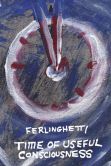
Book Review - Time of Useful Consciousness by Lawrence Ferlinghetti

Time of Useful Consciousness
Lawrence Ferlinghetti
Hard Cover
Publisher: New Directions
Publication Date: October 24, 2012
88 pages
ISBN: 9780811220316

Time of Useful Consciousness

     Lawrence Ferlinghetti’s Time of Useful Consciousness is a stream-of-conscious poem documenting the conflicted times, inspirational places, and larger-than-life personalities with which Lawrence Ferlinghetti lived and interacted. This is not a Ferlinghetti auto-biography. It is, however, an auto-biographical snap-shot that critiques an enigmatic yet dysfunctional America.

     The term “Time of Useful Consciousness” refers to the aeronautical idiom that identifies the length of time between when a pilot loses oxygen and when he passes out; that very short interval of time when the action to recover can be taken. Naming the work after this phenomenon seemed to me at first glance a bit unrelated to the content but Ferlinghetti’s belief that we are now, as a culture, living within such a moment brings it all into perspective. He delivers here a concise, cautionary tale of our increasingly gadget-, media-, and tech-obsessed culture, our self-indulgent mentality, and our arrogant outlook toward the rest of the world. With this work he adds to the distinctive saga which he began in Americus.

     When I read I generally record my first impressions and feelings of the work so that I have a starting point that I might use in my review. When I began Time of Useful Consciousness my first note was this: “Makes me want to grab a pencil and start documenting all the people, places, and events mentioned here. In fact, re-read it just for that purpose.” For me, Lawrence Ferlinghetti always creates entertaining and worthwhile poetry. He’s one of the few living poets that I seek out every time I go into a book store and for good reason – He’s an excellent poet of unnatural ability. Sometimes lost in the haze of the Beat movement Ferlinghetti is, in my opinion, one of the world’s most underrated (or perhaps, under the radar) poets and deserves serious study. Time of Useful Consciousness is a work that every aspiring poet should study and a must-read for anyone that cares about evocative poetry.

5 out of 5 stars

The Alternative
Southeast Wisconsin

Additional Reading:

Black Heart Magazine Review

San Francisco Chronicle Review

 Ferlinghetti Discusses Time of Useful Consciousness

New Directions Page

Signed Limited Editions

Lawrence Ferlinghetti’s Wiki Page

Lawrence Ferlinghetti’s City Lights Bookstore Page

Tuesday, January 01, 2013

Book Review - Revision 7: DNA by Terry Person

Revision 7: DNA
Terry Persun
Trade Paperback
262 pages
Publisher: Booktrope Editions
Publication Date: September 10, 2012
ISBN-13: 978-1935961871

clip_image002

     Terry Persun’s Revision 7: DNA is an exciting ride through such Science Fiction themes as the advent of early robotic invention (and how simple robots become more complex), time travel, artificial intelligence vs. sentience, megalomania, unconventional crime detecting, and new mind mapping techniques, all surrounded by a compelling, and quite entertaining, kidnap-mystery story.

     Neil Altman, a man whose parents severed the halves of his brain when he was a child and trained him to use each half independently and who happens to be a missing “things” finder, is called to a private think-tank to investigate a missing time machine. But Neil doesn’t believe in time travel and is more than a bit skeptical concerning the motives and actions of the scientists concerning the missing equipment. Expecting to discover a simple cover-up Neil begins his investigation with skepticism. Little does he know that what he uncovers will test his beliefs about the existence of time travel, the meaning of artificial intelligence, psychics that assist in solving crimes, private scientific experimentation, and robots. As the investigation unfolds Neil soon uncovers a ring of illegal time-shifting, humanoid robots that have kidnapped his wife, placing her life in jeopardy.

     Not far away an extremely curious, and very likeable, robot named Fenny is about to boot up the Revision 7 software which will change everything, allowing him insight into his unique gifts as he contemplates the meaning of sentience. As the robot struggles with its newly developing humanity Neil begins to understand how truly unique he is and how the two share a number of considerably important common traits.

     With the intelligent elements of Isaac Asimov’s Robot detective stories, the most endearing parts of Pixar’s Wall*E, the components of an exciting chase sequence, and a good murder mystery plot Terry Persun has, with Revision 7: DNA spun a unique robot/time travel/sentience story that delves into uncharted, yet believable, scientific realms.

     File with robots, artificial intelligence, and time travel.

4 stars out of 5

The Alternative
Southeast Wisconsin

Additional Reading:

Revision 7: DNA Amazon Page

Revision 7: DNA Excerpt

Terry Persun Official Site

Terry Persun Interview

Wednesday, November 14, 2012

Book Review - The Frozen Sky by Jeff Carlson

The Frozen Sky
Jeff Carlson
Print Length: 348 pages
eBook: 472 pages (portrait mode)
Publisher: JVE
Publication Date: October 10, 2012
eBook ISBN: 9781936460137
Orbital Diagrams and Maps: Jeff Sierzenga
Interior Illustrations: Karel Zeman
Cover Art: Jacob Charles Dietz

image

     Well before the printed word critics and reviewers alike debated over what made a good story and, conversely, what made a story good. Fortunately, those answers still remain a matter of individual opinion1. Better still, I like to express my opinion about the books I’ve read. (I have a keyboard and I’m not afraid to use it.) One of my own long-standing gauges for identifying a remarkable book2 hinges on a simple principle. If the narrative personally motivates me to sit down and write then I know that it wholly entertained, profoundly inspired, and/or emotionally stirred me in some way. It doesn’t matter that I’m not a novelist. That I WANTED to pick up pen and paper and write immediately after finishing Jeff Carlson’s The Frozen Sky is the important factor. As a reader the spark of inspiration, that need to create, is a tell-tale sign that a connection has been made, that I’ve discovered a truly provocative story of worth and value3. Simply put, The Frozen Sky is very much the story I’d want to write myself (if I lived in an alternate universe where I created best-selling Science Fiction.)

     Based on the award-winning4 novelette of the same name The Frozen Sky is a new, full-length Science Fiction thriller that in many ways compares to the classic ‘First Contact’ novels Footfall by Larry Niven and Jerry Pournelle and Mindbridge by Joe Haldeman. The idea that humans will encounter problems communicating with aliens is not at all a new concept but Mr. Carlson may have identified a few of the potential stumbling blocks we could face when trying to make ourselves understood. The near-impossible seeming task of “talking” to another race will certainly be a challenging experience but, if we learn from the “what if’s” posed by Mr. Carlson and his fellow Science Fiction writers it need not be a traumatic one. Despite the ‘hard’ Science Fiction label The Frozen Sky is not at all difficult to read. In fact, I finished it rather quickly and was thoroughly entertained by the creative premise, the right amount of page-turning action, the character development, and the plausible argument for keeping our heads when we start to physically explore our neighboring solar system.

     A planetary rover, sent to discover natural resources for a dying, war-ravaged Earth, encounters signs of life on Europa, the ice-rich moon of Jupiter. A robotic probe has discovered a millennia-old tunnel engraved with hieroglyphic symbols. And, where there’s language there’s civilization. Except, in this case the alien race encountered by an elite team of scientists is older than mankind and, because of the harsh environment, has regressed to an unusually barbaric state. With the help of a human-A.I.-hybrid hastily uploaded to a mech, one scientist fights time, newly-landed competitors from Earth’s remaining superpowers, and the aliens themselves to prove that the new race is sentient. But the military applications, mineral mining, and water-rich environment of Europa are too lucrative and tempting to an impatient Earth. Time is running out and there are factions on Europa that would rather eliminate the newly-encountered race than talk to it.

     In my opinion, The Frozen Sky coupled with his Plague series makes Jeff Carlson a logical heir of the Golden Age writers such as Isaac Asimov, Robert H. Heinlein, and Arthur C. Clarke. And we definitely need writers like Carlson to fill the void left by their passing. Not only does Carlson provide impactful science fiction but he also knows how to convey the nuances of the human condition in his storytelling. The Frozen Sky is an exceptional piece of Science Fiction, and is evocative, entertaining, and on par with the hard Science-Fiction5 works of the writers mentioned above. It adds to Carlson’s existing body of work and I feel strongly that one day it will be regarded as one of the classic works of Science Fiction. Jeff Carlson creates fascinating non-terrestrial landscapes, technological gadgets, and alien creatures like a painter designing his masterpiece or a composer creating his magnum opus. Epic in scope The Frozen Sky is a fast-paced First Contact story like none I’ve ever read before and deserves a wide audience and an avid following.

     Recommended for fans of alien encounters/first contact, hard Science Fiction, military fiction, action adventure, electronic warfare, Artificial Intelligence, planetary rovers, hacking, space travel, terra-forming/exploitation, environmental suits, computer simulations, humanism, alien life forms, the sentience argument, rogue A.I. probes, memory transference, and space exploration.

     File with: Isaac Asimov, Robert A. Heinlein, Frederick Pohl, Jack McDevitt, Poul Anderson, Larry Niven, Iain M. Banks, China Meiville, and Arthur C. Clarke.

     Note: The ePub version of the book contains a very entertaining story from Jeff Carlson’s short story collection Long Eyes and Other Stories entitled “Pressure.”

4 ½ out 5 stars

The Alternative One
Southeast Wisconsin

Additional Reading:

Read the novelette of The Frozen Sky

Review of The Frozen Sky

The Frozen Sky Amazon Page

Jeff Carlson Wiki Page

Jeff Carlson Official Author Page

clip_image004

Illustration Karel Zeman
Copyright 2009
Pevnost Magazine

1 Many a beloved classic have garnered bad reviews over the years. Some still do.  Click here for a short list.

2 A virtual index of my physical library can be found here: The Alternative

3 I equate this to when, as little boys, my brothers and I would get energized after watching a sporting event on TV and then would immediately run out to play that sport. That excitement, that spark, is a true indicator that I’ve been immersed in a good piece of fiction and was “inspired to play.”

4 First-place winner in the international Writers of the Future contest.

5 A word about “hard” Science Fiction by Mike Brotherton (and recommended reading) can be found here: Ten classic hard SF novels featuring Physics and Astronomy

     Disclaimer: The eBook version of The Frozen Sky was obtained gratis as part of the Early Reviewers Program at www.LibaryThing.com. The Alternative One Blog does not accept compensation, other than reading material, for its reviews.

Friday, November 02, 2012

Concert Review – Jethro Tull’s Ian Anderson Plays Thick As A Brick 1 & 2

(November 1st, 2012 – Pabst Theatre, Milwaukee, WI.)

clip_image002

Watching the Minstrel from the Gallery

     From our perch high up in the Gallery at the Pabst Theatre last night we witnessed a spectacle of musical diversion not seen in the Midwest in a very long time. Ian Anderson and “chums” performed the classic prog-rock concept album Thick As A Brick 1 AND its new companion album Thick As A Brick 2 back-to-back, live, on-stage. It was an event of extraordinary performance art, head banging rock, musical theatre, visual arts and one great, kick-ass piece of mind-boggling musical entertainment. Ian Anderson, long-time front-man for Jethro Tull, is unarguably one of the most charismatic performers in the industry and the world’s most gifted flautist. And he proved it last night.

     Replete with a new touring band and a new backup singer who sounds astonishingly like a young Ian Anderson the band played through Thick As A Brick 1 & 2  in an energetic, theatrical performance. New and well-known melodies and themes were resurrected and rolled up into a suite of profound sound and expanded into a two-and-a-half-hour adrenaline-filled  show. Ian Anderson’s robust vocals, shared with Ryan O’Donnell, were solid and his flute and acoustic guitar work flawless. Lead guitarist, Florian Ophale, a gifted musician, definitely did his homework as both his lead and rhythm works were outstanding. Keyboardist, John O’Hara, is a talented and multi-layered instrumentalist that utilized the piano, organs, and an accordion throughout the performance. Drummer, Scott Hammond, was fluent, fluid, and provided a jarring, romping five minute drum solo that rocked the house.

     All in all, this was one of the very best throw-back rock concerts I’ve attended in recent years (beating out Eric Clapton, Santana, and yes, even Pearl Jam) and in my opinion, fulfilled every Tull fan's most fervent dream… stripped-down folksy acoustic guitar, flute musings, rollicking electric guitars and synthesizers bracketed by tight rhythm-section accompaniment, inspired musicianship, entertaining visual performance art (at one point Ryan O’Donnell sat on stage pretending to read a copy of PROG magazine), and the liquid but brawny vocals and humorous storytelling of Ian Anderson. Not surprisingly, this performance, as well as their entire body of music over the past forty years, incorporated elements of classical music, theater, English folk music, jazz, British humor, hard rock, erudite storytelling, and art rock into their sound. Exactly what every fan there came to see.

Performance 5 out of 5 stars
Musicality 6 out of 5 stars
Visual arts and storytelling 5 out of 5 stars

The Alternative
Southeast Wisconsin

clip_image004

Additional Reading:

Official Jethro Tull Website

Jethro Tull Wiki Page

Ian Anderson Wiki Page

Thick As A Brick 1 Wiki Page

Thick As A Brick 2 YouTube Trailer

clip_image006

Monday, October 29, 2012

Book Review - Miss Peregrine’s Home for Peculiar Children by Ransom Riggs

Miss Peregrine’s Home for Peculiar Children
Ransom Riggs
Hardcover: 352 pages
eBook: 361 pages (Portrait view)
Publisher: Quirk Books
Publication Date: June 7, 2011
eISBN: 978-1-59474-513-3
ISBN-13: 978-1-59474-476-1
Cover Photograph: Courtesy of Yefim Tovbis

clip_image002

     Miss Peregrine’s Home for Peculiar Children…
     Home for Peculiar Children…
     Peculiar Children…
     The title suggests to me that its pages have to be filled with all things gothic, dark, melancholy, and, for lack of a better word, peculiar. The cover image of a girl floating six inches off the ground grabbed my attention adding an air of mystery and implying that something profound and extraordinary was about to happen. All I had to do was open the book to find out what made these particular children so different. So, I wasted no time in doing just that and found myself wholly fascinated and entertained by the story. Ransom Riggs has created a world of imagination filled with mystery, time loops, magic, monsters, and yes, some very uncommon “children.” Miss Peregrine’s Home for Peculiar Children is an exceptional novel and I found myself entranced by Riggs’s voice and captivated by the notion that something ominous was about to happen every time I turned a page. It’s a remarkable story that blends a murder mystery, a quest motif, and a coming-of-age tale with the supernatural to create a masterful piece of lasting fantasy. The story is intelligent and engrossing and filled with old sepia-toned photographs that depict unfamiliar and titillating characters situated in not-quite-natural poses or evocative scenes. My curiosity became piqued the moment I saw them. The photos were strange but somehow made sense. They begged examination. They filled gaps. They complimented the story. And they helped to explain that “peculiar spirits” still walk the Earth.

     Jacob, a 16 year old American, has listened to his grandfather’s tall-tales for years but attributes the chilling stories of cunning monsters and strange characters to his grandfather’s unusual experience as a World War II orphan. (After losing his family to the Nazis Grandpa Abe was shipped off to England where he found himself a ward of Miss Peregrine on the tiny island of Cairnholm off the coast of Wales.) One day Jacob receives a panicked, confused call from his grandfather and rushing off to find out what’s happened he discovers his grandfather bleeding and dying in the woods behind his home. His last words, “September 3rd, 1940…. Emerson… Find the bird in the loop…” are a mystery to Jacob but as his grandfather’s life fades away his flashlight reveals the hideous face of a monster lurking in the woods. Jacob realizes that his grandfather’s stories were not fabrications after all and he knows that his world will never be the same. When he finds a letter written to his grandfather by Miss Peregrine Jacob knows he must find out who, or what, killed him and why. Using the excuse that visiting the island would ease the trauma Jacob convinces his psychiatrist and his family to let him visit the “Home” where his grandfather spent his childhood. Once in Wales, with his dad in tow as chaperone, Jacob stumbles upon a group of very unusual children. He learns that his grandfather’s stories were more truth than fantasy and that he is not as common as he once thought. The world he lived in was never at all what it seemed. Miss Peregrine and the children, hidden in a time loop for the better part of sixty years, are being hunted by monsters and it falls on Jacob’s shoulders to protect them at all cost.

     Recommended for time travel buffs, psychological horror fans, murder mystery aficionados, fantasy lovers, Young Adult fans, or anyone looking for an interesting or “peculiar” read. Also recommended for fans of Theodore Sturgeon’s More Than Human or Zena Henderson’s “People” stories.

4 ½ out of 5 stars

The Alternative
Southeast Wisconsin

Additional Reading:

Miss Peregrine’s Home for Peculiar Children Amazon Page

 Miss Peregrine’s Home for Peculiar Children Wiki Page

Miss Peregrine’s Home for Peculiar Children You Tube Book Trailer

Miss Peregrine’s Home for Peculiar Children Excerpt (Prologue and 3 chapters)

 L.A. Times Article

Ransom Riggs’s Official Website

clip_image004

A word (or three) about the peculiar photographs –

     Ransom Riggs came up with the idea for Miss Peregrine’s Home for Peculiar Children after stumbling upon a number of “found” vintage photographs. Mixed throughout the book are many of these unusual, sometimes spectral, sepia-toned images. Hoax, “Spirit”, and fake photographs were mass-distributed around the turn of the last century as a means to gain popularity or make money and have been around almost as long as the art of photography. That so many of them survive is a testament to those who collect and preserve them. The images presented in the novel are suggestive of a bizarre nature or contain an illusion-like oddity or uncommon scene and as I continued to read I looked forward to seeing more of them. There was something compelling and altogether eerie about every image and I wanted to meet the characters shown in them and hear their individual stories. Riggs integrated the unrelated images into the novel perfectly fitting them together like the pieces of a puzzle. A woman in period clothes holding a parasol became Miss Peregrine, an old subway tunnel became the entry to a time loop, and so on. As the story unfolded in his imagination Riggs started searching for similar photos. He went to swap meets and flea markets and was allowed access to photographic collections to search for more “peculiar” images to help propel the story forward. The afterward contains a listing of all the images used and the collections they’re from. In an interview, Riggs told fans that he’s compiled a huge backlog of additional images for a sequel. I, for one, can’t wait to see what the next installment brings us.

Wednesday, October 24, 2012

Book Review - The Sisters Brothers by Patrick deWitt

The Sisters Brothers
Patrick deWitt
Paperback version 336 pages
eBook version: Portrait 368 pages
Publisher: Ecco (Harper Collins)
Publication Date: February 14, 2011
ISBN-13: 978-0062041289

clip_image002

     The best thing about Patrick deWitt’s novel The Sisters Brothers is that it is an inventively unusual and magnificently flowing piece of fiction. (For those of you wishing to pad your reading list for the year this book is an extraordinarily quick read and I found it nearly impossible to put down.) The language is strong, in plot and content, the story compelling, exciting and creative, and the characters, while flawed and slightly comical and buffoonish, are totally believable and empathetic, especially the narrator. It takes a special story to interrupt my customary fare of Science Fiction and Fantasy and The Sisters Brothers is just that. It was so exceptional, in fact, that it wiggled its way into my already-waiting-to-tip-over reading pile. When I started it I didn’t realize that it was a Western, a genre I don’t normally read, but the blurbs and back-cover description gave an “otherworldly” or “sinister” vibe to me which was the deciding factor. Once I began reading, however, I was hooked. Additionally, the cover art and title seemed both unusual and remarkable in their own ways and I wanted to know more about the characters depicted there. (It turns out that sometimes you CAN judge a book by its cover.)

     The Sisters Brothers is dark, disturbing, gory, bloody and, above all, great fun to read. It’s packed with home-spun wisdom, wagon-train philosophy, and frontier angst and is a creative and unique blending of a time-worn genre and contemporary thought. What I find interesting is that this atypical, Western-inspired tale does not follow customary themes (i.e. Cowboys versus Indians, The 7th Cavalry arriving in the nick of time, a lone gunman seeking retribution against past wrongs, or an evil cattle baron buying or stealing all the land in the peaceful valley.) It seems that Mr. deWitt is a frontier philosopher of sorts and those values rub off marvelously on his characters. Assassins inclined to discuss their own brand of twisted philosophy prior to heading off into a gunfight? Priceless! There are numerous quests and a few missions and lots of bloodshed and a double-cross or two. There are gunfights and surprises, and animal husbandry and a bit of cruelty, and prospecting for gold, and insanity, and dirty characters, inside and out. There’s arrogance and a price to pay for it in many guises. There’s humility and reward, albeit somewhat unsatisfactory for the character in question. There are attitudes of the frontier and the trail and there’s bloodlust and violence everywhere and the mentality of gunfighters can be found on almost every page. But there are many unique ideas and themes here that you will not find in other Westerns. Most noticeably is a strong, quick, un-squandered language that fits perfectly within the genre yet flows exquisitely. And that language helps make Patrick deWitt’s re-envisioning of the Wild Old West feel more authentic and realistic.

     The two main characters, Charlie and Eli Sisters, are well-known gun slingers in and around Oregon and northern California and the mere mention of their names can bring hard men to their knees and send weak men running for the hills. But the Sisters brothers are psychologically flawed from a young age. Witnesses to the brutal beating of their mother by their father and the subsequent murder of their father by Charlie, the two six-gun-toting brothers couldn’t be more different. Charlie is tortured, arrogant, and tough and Eli is complex, sensitive, and often tender-hearted. And while Charlie kills for the sport and pleasure of it Eli kills to protect his older brother who saved him from a life of abuse. The Sisters Brothers is, in essence a quest story. Charlie and Eli are sent by their boss, The Commodore, to kill Hermann Kermit Warm, a supposed thief, and return to Oregon with his secret formula for easily extracting gold from the rivers. But this is not the main quest of the book. The true pursuit is the search for self and the realization that what we do in our younger years molds us into who we are to become as adults. The human drama is laid bare but you have to peek around the gun fights, between the fist fights, the drunken debauchery, the mind-numbing hours on horseback, the dirt coffee, and the mindless prospectors that have been too long in the wilderness to find it. Look hard. It’s there. The exploration is well-worth the price of admission.

     By all accounts this book should have tanked with me (according to my genre choices and reading preferences.) But, here’s the thing, as soon as I started reading it I knew that I wouldn’t be able to put it down. It was that captivating, that unique, and that sublime. Never before have I reviewed a semi-historical Western but, as they say, “things change” and so I am reviewing this romp through the Old West and gladly so. Why? To use the vernacular, it’s a “damn fine” story, that’s why.

4 ½ stars out of 5

The Alternative One
Southeast Wisconsin

     Recommended if you appreciate Westerns, exceptionally plotted narratives, action-packed gun and fist fights, old west debauchery and saloons, unscrupulous men and their corrupt actions, and home-spun comedy combined with a bit of cowboy buffoonery.

Additional Reading:

The Sisters Brothers Wiki Page

The Sisters Brothers Amazon Page

Chapter One Excerpt of The Sisters Brothers

Chapter One Audio of The Sisters Brothers

The Sisters Brothers Facebook Page

Patrick deWitt Official Author Page

Friday, October 19, 2012

Book Review - Cloud Atlas by David Mitchell

Cloud Atlas
David Mitchell
Random House Trade Paperbacks
First Edition - August 17, 2004
ISBN-13: 978-0375507250
528 pages

clip_image002

In many of my past book reviews I’ve discussed the concept of the writer’s voice when describing style, inventiveness, and thought-provoking, imaginative, and inspired literature. In the case of David Mitchell his voice resonates with unquestionable clarity and Cloud Atlas, which to me reads more like poetry than prose, is an outstanding opus for any genre. Indeed, by its nature, it cannot be simply pigeon-holed into any one genre but skirts the neighborhood of many. Masterful story-telling combined with creative plots and twists and turns make Cloud Atlas my favorite book of the year and is, in my opinion, a near-perfect work of fiction and an instant classic. Mr. Mitchell has crafted an interesting and entertaining tale filled with curious themes and remarkable elements that effortlessly tie together in some fashion or another, usually via a common thread (i.e. Movies, books, music, or people.)Themes of reincarnation, attempted murder, pirates and sailing on the high seas, the human drama, Science Fiction, suicide, dystopian society, poetry, succinct language (no one does two and three word sentences better), Fantasy, corporate cover-up, sex, altruism, and survival are all expertly and brilliantly represented in this multi-player and multi-thematic story.

Cloud Atlas is divided into six interrelated story-lines narrated by as many diverse characters and ascends up through history from the mid-19th century into a distant post-apocalyptic future world. The stories are all interlinked expertly using either certain reoccurring (reincarnated?) individuals and/or their associates or by the letters, music, or lives that they’ve touched. Everything is connected and spiked with head-spinning Déjà vu.

In the first vignette, written in the form of diary entries, we learn of Adam Ewing, a writer out to make a name for himself and his fateful trip from New Zealand to O-Hawaii in 1849. (Note: For some this may be the most difficult chapter in the book to read (the style is period) but stick with it - the rewards are entirely worth the work.) The book concludes with the sad story of Mr. Ewing and the hardship he suffers at the hands of a devious scam artist.

The second chapter introduces con-man Robert Frobisher who has been forced to vacate Europe due to a long history of philandering, gambling, cuckolding, and debt (in some cases all four simultaneously.) Frobisher decides to ingratiate himself into the lives of an aging but brilliant music composer and his wife and daughter in an attempt to gain employment and advance. His story is revealed in a number of letters to his friend and sometimes bi-sexual lover Rufus Sixsmith. (Aside: The number six, which is the number of harmony and balance, also recurs many times throughout the story.)

The third novella centers on Luisa Rey, a reporter, who has stumbled onto a huge corporate cover-up that could push the world over the edge of self-destruction. What she learns from scientist Rufus Sixsmith (the same considerably older character mentioned earlier) could change the course of history – if she can survive long enough to tell the story.

The fourth short story is extremely entertaining and could have been written for the Twilight Zone or Outer Limits. Timothy Cavendish, a book publisher, has recently achieved sudden and immense wealth by publishing the memoirs of a man that committed an unexpected murder. When the man is sentenced to prison Cavendish reaps the benefits of the popularity of the book but must contend with the murderer’s unsavory family. Mr. Cavendish’s unhappy fate is poignant, disturbing, and in some ways predictable.

In the fifth section Somni -451, a fabricant (or clone), has been pulled from her service job waiting tables and serving food at Papa Song’s to be used (and abused) as an experiment by a wealthy college post-grad. Unfortunately, her freedom comes at a very high price.

The sixth chapter, the centerpiece of the book, is my favorite. Written in the colloquialism of the post-apocalyptic Hawaiian (Ha-Way) Islands the language takes some getting used to (I found it easier to read it quickly.) But the story itself is very compelling and filled with unique and creative dystopian tropes that will leave even the most jaded readers in awe of Mitchell’s skill. Technology, for the most part, is gone and the denizens of Hawaii have been living subsistence existences for years, But, when a ship arrives with people who use “old-un” technology things are about to change. And not at all how anyone expects them to…

Cloud Atlas does not end there, however. Each chapter, and subsequent story, folds back onto itself in opposite order to be neatly and comprehensively pieced back together and the preceding loose ends tied up into a climactic ending that is altogether brilliant, inventive, and concise. This is literature at its best combining fragments of Science Fiction, Fantasy, drama, mystery, post-apocalyptic dystopia, and the human condition together into a highly entertaining and spell-binding read. Cloud Atlas is a magnificently crafted and indelible work of fiction. Thank you Mr. Mitchell, it is definitely one of my top ten island reads.

I have never read any of Mr. Mitchell’s work before but I certainly will now… look out Amazon.com here I come, credit card in hand!

Recommended for, well, everyone…

6 out of 5 stars

The Alternative
Southeast Wisconsin

Additional Reading:

David Mitchell Amazon Page

Cloud Atlas Amazon Page

Cloud Atlas Extended Movie Trailer

Huffington Post Review of Cloud Atlas

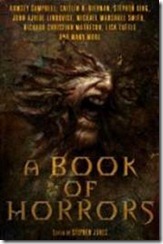
Book Review - A Book of Horrors - Stephen Jones (Editor)

A Book of Horrors (Anthology)
Stephen Jones (Editor)
Trade Paperback
St. Martin's Griffin
September 18, 2012
448 pages
ISBN-13: 978-1250018526

clip_image002

In the anthology A Book of Horrors we are treated to a number of very good genre stories by some of the most talented writers in fiction today. While not every story is satisfyingly scary enough to send us under the covers or give us the cold shivers its refreshing to find that the genre is comprised of more than glowing vampires and six-pack wielding werewolves. On the contrary, the world of horror fiction still thrives beneath the weight of paranormal romance and while I firmly believe there is room for every sub-category of the genre it’s good to see that traditional horror stories are still being written and sold. Though not really a revival, since conventional horror never really died off, I do think it important that works of this nature, in the short form, find their moments in the limelight. I’ve said it many times before, horror has never been my favorite genre but, when done right, and theses stories are done right, they can be as entertaining as any form of fiction on the planet. In fact, most of my very favorite stories have some element of horror in them and that’s not a bad thing at all.

A Book of Horrors is recommended for fans of Stephen King, conventional or traditional horror, paranormal mystery, and spooks that go bump in the night.

Contents:

Stephen King - "The Little Green God of Agony"
*Caitlin R. Kiernan - "Charcloth, Firesteel and Flint"
Peter Crowther - "Ghosts with Teeth"
*Angela Slatter - "The Coffin's-Maker's Daughter"
Brian Hodge - "Roots and All"
Dennis Etchison - "Tell Me I'll See You Again"
*John Ajvide Lindqvist - "The Music of Bengt Karlsson, Murderer"
*Ramsey Campbell - "Getting it Wrong"
Robert Shearman -"Alice Through the Plastic Sheet"
Lisa Tuttle - "The Man in the Ditch"
Reggie Oliver - "The Child's Problem"
Michael Marshall Smith - "Sad, Dark Thing"

3 ½ stars out of 5

The Alternative
Southeast Wisconsin

* The strongest stories in the collection.

Additional Reading:

Stephen King’s Official Website

Caitlin R. Kiernan’s Official Website

Peter Crowther’s Official Website

Angela Slatter’s Official Website

Brian Hodge’s Official Website

Dennis Etchison’s ISFDB Page

John Ajvide Lindqvist’s Official Website

Ramsey Campbell’s Official Website

Robert Shearman’s Official Website

Lisa Tuttle’s Official Website

Reggie Oliver’s ISFDB Page

 Michael Marshall Smith’s Official Website

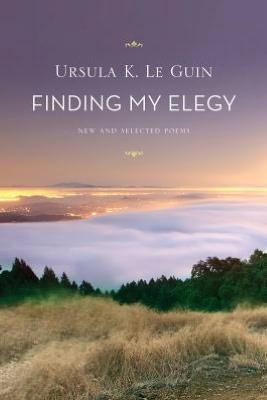
Book Review - Finding My Elegy: New and Selected Poems by Ursula K Le Guin

Finding My Elegy: New and Selected Poems
Ursula K. Le Guin
Trade Paperback
208 pages
Publisher: Houghton Mifflin Harcourt
Publication Date: September 18, 2012
ISBN-13: 978-0547858203
Advance Reader’s Copy – Uncorrected Proof

Le_Guin_Elegy

     In her eighty-third year Ursula K. Le Guin may very well be searching for her own elegy but her newest collection of poetry is by no means a swan song. If we define elegy as a funeral song or dirge then perhaps Ms. Le Guin has published Finding My Elegy as a memento for future generations. I think this extremely unlikely, however. In fact, if we define elegy as a composition of poetry (it’s sister meaning) then I believe Ms. Le Guin, as seasoned a writer as she is, simply continues her writing process by searching for her own unique, poetic voice. Only a true poet would carry on the quest for lyrical inspiration well into their eighth decade. The muse is a moving target and as every writer knows that voice, the essence, is always in  motion and must forever be pursued. It can never be accepted as is since it is evolving, ever-changing, and frail to the touch.

     There’s no question that Ursula K. Le Guin is one of our most gifted authors and while I have always appreciated and loved her body of fiction I know that it takes a certain amount of courage, even by an established legend, to write and publish poetry. Those singular glimpses into the personality and soul, however fleeting, is something most writers would rather not expose. I wish other celebrated Science Fiction writers would follow suit. What would the biggest names in the genre today have to say in the short poetic form I wonder? Mieville, Hill, Gaiman, Atwood, Scalzi, Walton, Stephenson, et al. consider that a challenge, if you will. What might we have learned if Clarke, Asimov, Heinlein, or Pohl had written poetry from their distinctive perspectives? I for one want to thank you, Ms. Le Guin, for your thought-provoking work, your daring, and for giving us your little book of collected poetry and for providing us a much too-short glimpse into your heart of hearts.

4 ½ out of 5 stars

The Alternative
Southeast Wisconsin

** Disclaimer – Advance Reader’s Copy – Uncorrected Proof received free from the Amazon Vine Program for review.

Additional Reading:

Ursula K. Le Guin Official Website

Ursula K. Le Guin Wiki Page

Finding My Elegy Amazon Page

Thursday, October 04, 2012

Coming soon....

The following book reviews are scheduled for October (not necessarily in this order):

The Book of Horrors - Stephen Jones (Ed.)
Cloud Atlas - David Mitchell
Revision 7: DNA - Terry Persun
Death Warmed Over (Dan Shamble, Zombie P.I.) - Kevin J. Anderson
Finding My Elegy: New and Selected Poems - Ursula K. Le Guin
Containment - Christian Cantrell

Tuesday, August 28, 2012

Book Review - Shadow Show - Edited by Sam Weller and Mort Castle

Shadow Show: All-New Stories in Celebration of Ray Bradbury
Sam Weller and Mort Castle, Editors
Trade Paperback
Publisher: William Morrow & Company
Publication Date: July 2012
464 pages
Advance Readers Copy – Uncorrected Proof

clip_image002

Table of Contents
Sam Weller and Mort Castle - Introduction
Ray Bradbury - Second Homecoming
*Neil Gaiman - The Man Who Forgot Ray Bradbury
*Margaret Atwood - Headlife
Jay Bonansinga - Heavy
*Sam Weller - The Girl In The Funeral Parlor
David Morrell - The Companions
Thomas F. Monteleone - The Exchange
Lee Martin - Cat on a Bad Couch
*Joe Hill - By The Silver Water Of Lake Champlain
*Dan Chaon - Little America
John McNally - The Phone Call
Joe Meno - Young Pilgrims
Robert McCammon - Children Of The Bedtime Machine
*Ramsey Campbell - The Page
Mort Castle - Light
Alice Hoffman - Conjure
John Maclay - Max
Jacqueline Mitchard - Two Of A Kind
Gary Braunbeck - Fat Man And Little Boy
*Bonnie Jo Campbell - The Tattoo
Audrey Niffenegger - Backwards In Seville
* Charles Yu - Earth: (A Gift Shop)
Julia Keller - Hayleigh's Dad
Dave Eggers - Who Knocks?
Bayo Ojikutu - Reservation 2020
Kelly Link - Two Houses
Harlan Ellison - Weariness

One of the most important contributions to literature that Ray Bradbury gave us was NOT his Science Fiction stories. If you’re surprised by that statement then you obviously haven’t read much Bradbury. While he was mostly a Science Fiction author (The Martian Chronicles, Fahrenheit 451, The Illustrated Man) every one of his stories (short or long) is steeped in the emotional values and humanism of his characters. Ray Bradbury was an evocative writer who posed the “What if?” question better than most and provided provocative answers to those same questions through his characters. Shadow Show, the tribute anthology to celebrate the career of Ray Bradbury, if nothing else, tells us how Ray Bradbury affected his audience. To bring together some of the biggest names in speculative fiction to celebrate the man is a great indication of his affect on some of the most creative writers in the industry.

When paying homage to a literary legend it is common for editors to become overly maudlin or include patronizingly syrupy content. Shadow Show, a tribute to Ray Bradbury, does not fall into the trap of over-sentimentalism and while not all the stories here emulate Mr. Bradbury’s style they all were obviously inspired by his writings. In Shadow Show, editors Sam Weller and Mort Castle have assembled short stories from a number of the world’s most gifted authors to honor Ray Bradbury and his contribution to the literary world of fiction. Also included is an Introduction in the form of a personal essay "Second Homecoming", written by Ray Bradbury, specifically for the book. Best stories in the anthology: Headlife by Margaret Atwood, The Man Who Forgot Ray Bradbury by Neil Gaiman, Little America by Dan Chaon, Earth: (A Gift Shop) by Charles Yu, and By the Silver Water of Lake Champlain by Joe Hill. A special nod to the Campbell’s here, as well. Ramsey Campbell for The Page and Bonnie Jo Campbell for The Tattoo titles that evoke Fahrenheit 451 and The Illustrated Man, respectively.

* Denotes my favorite stories in the anthology.

** Advance Readers Copy – Uncorrected Proof from LibraryThing.com Early Readers Program

4 ½ stars out of 5

The Alternative
Southeast Wisconsin

Additional Reading:

Ray Bradbury Official Site

Ray Bradbury Wiki Page

Harper Collins Sam Weller Page

Shadow Show Amazon Page

Sunday, August 05, 2012

Book Review - 21st Century Dead (A Zombie Anthology) Edited by Christopher Golden

21st Century Dead (A Zombie Anthology)
Editor: Christopher Golden
Publisher: St. Martin's Griffin
Publication Date: July 2012
Trade Paperback
352 pages
Advance Readers Copy – Uncorrected Proof

clip_image001

Short fiction has always been problematic for me. Even the best anthologies sometimes fail to hold my interest for very long. In addition, there’s the long-argued dilemma of how to review an anthology. Should the book be reviewed as a single entity or should each story be reviewed separately?  What makes matters infinitely worse for me is that five of the last seven books I’ve received for review are short story anthologies.  Guess it’s time to make up my mind… or not.

So, zombies, right? What could possibly be wrong with a short story anthology featuring zombies? In the case of 21st Century Dead? Absolutely nothing! Infinitely better is that Chris Golden has brought together some of the most unusual and interesting “zombie” stories ever written. This is not your usual faire of shambling undead but a strange mixture of victims, weirdoes, and the most maladjusted walkers and non-zombie zombies in the history of all lifeless, ambling brain-eaters.

The first three stories, for instance, do not fit any “normal” zombie mold. Chelsea Cain’s Why Mothers Let Their Babies Watch Television is a lesson in why zombie babies should be allowed to watch TV. In Carousel by Orson Scott Card we are given a new perspective by a post-living person. (“It’s all poop!”) And when the dead are suddenly resurrected a discussion with God at the Carousel puts an end to all the suffering. In Reality Bites by S. G. Browne we see Reality TV with a twist. The Zombie Jersey Shore. The Amazing Zombie Race. American Zombie Idol. What if a TV exec discovered a rationalizing, lucid, talking zombie? Now that would be quite the Reality Bite…

Given the unique and constructive names given to the zombies in the various stories here (Infects, NODS, and Dead Ones, among others) and how zombie-ism is spread (a virus, drugs, and the apocalypse) we begin to see that the 21st Century Dead is not your typical shambling zombie anthology.  I should also mention that the stories are overloaded with social media, TV, Hollywood, and advertising. In that sense alone this anthology truly represents the 21st Century Dead.

Table of Contents:

Biters by Mark Morris
Why Mothers Let Their Babies Watch Television: A Just-So Horror Story by Chelsea Cain
Carousel by Orson Scott Card
*Reality Bites by S.G. Browne
The Drop by Stephen Susco
**Antiparallelogram by Amber Benson
How We Escaped Our Certain Fate by Dan Chaon
A Mother's Love by John McIlveen
*Down and Out in Dead Town by Simon R. Green
*Devil Dust by Caitlin Kittredge
The Dead of Dromore by Ken Bruen
All the Comforts of Home: A Beacon Story by John Skipp and Cody Goodfellow
Ghost Dog & Pup: Stay by Thomas E. Sniegoiski
*Tic Boom, a Love Story by Kurt Sutter
*Jack and Jill by Jonathan Maberry
Tender as Teeth by Stephanie Crawford and Duane Swierczynski
Couch Potato by Brian Keene
*The Happy Bird and Other Tales by Rio Youers
Parasite by Daniel H. Wilson

* Denotes the stories I felt were the strongest in the anthology.

** Note to Amber Benson: Antiparallelogram needs to be written into novel. It’s too good a story to languish as a short zombie story. Everyone I know that has read it wants to know what happens next.

4 out of 5 stars

The Alternative
Southeast Wisconsin

Additional Reading:

21st Century Dead Amazon Page

21st Century Dead MacMillan Page

21st Century Dead Facebook Page

Official Christopher Golden Page

Christopher Golden Wiki Page

Saturday, August 04, 2012

Book Review - The Prankster by James Polster

The Prankster
James Polster
Novella
Trade Paperback
122 pages
Publisher: 47North
Publication Date: July 10, 2012
ISBN-13: 978-1612183633
Advance Readers Copy – Uncorrected Proof

clip_image001

With a skewed take on game shows, slick advertising, televised practical jokes, and the very human need to be entertained James Polster’s The Prankster holds a mirror to our singular obsession with vanity and our excessive need for constant diversion and distraction.

In a far off galaxy on an alien world, The Prankster, the most popular reality game show in the universe, suffers a slip in time and the host and his assistant become trapped in the very place they’ve spoofed on live television for many years. Pom Trager has become accustomed to using the Earth, and many of its most famous people and places, for his show’s pranks and practical jokes to boost ratings. But a system glitch traps him on Earth and an ever-closing window of time gives him less than 48 hours to get from New Mexico to San Francisco. Since air travel will mess with the time/spatial continuum an old fashioned road trip is the only way they can travel.  A mistrustful Earth woman accompanies them on their journey as a relentless and suspicious sheriff follows their trail. With only one chance at rescue the two time travelers must either make it to their destination in time or become forever trapped on an Earth lost in the past.

Recommended for Science Fiction fans, time travel freaks, talk show activists and anyone interested in a fast-paced, character-driven story that pokes fun at the human need to be constantly immersed in entertainment.

Recommended Reading – He Walked Among Us by Norman Spinrad, Year Zero by Rob Reid, Hitchhikers Guide to the Galaxy by Douglas Adams, Wrack & Roll by Bradley Denton and My Favorite Band Does Not Exist by Robert T. Jeschonek.

Back in June of 2011 I reviewed Polster’s The Graduate Student for this book review blog. This is what I had to say about the author then:

“James Polster has, in my opinion, a home-spun, blue-collar humor that reminds me of some throw-back Kurt Vonnegut/Hunter Thompson/Carl Hiaasen construct. He takes turns at being subtly and blatantly humorous with both high-brow twists and guttural turns - sometimes, in the same scene. Once you read his bio page you’ll ask yourself if art, in this case, isn’t imitating life. (It is, BTW since Polster actually travelled the Amazon River basin, lived the life of a grad student, and worked for a major television station.) I found a certain underlying level of comfort in Polster’s writing style. By that I mean he creates an intelligent story that is easy to read, contains fast-paced language, and is both clever and humorous. However, The Graduate Student is not a laugh-out-loud belly romp but rather is filled with delightful servings of understated, intelligent, thinking-man humor.”

It’s no less true with The Prankster.

3 ¾ stars out of 5

The Alternative
Southeast Wisconsin

Additional Reading:

The Prankster Amazon Page

James Polster Wiki Page

About the Author (from Amazon.com):

Equal parts novelist, journalist, explorer, and movie producer, James Polster draws on his rich cultural experiences to craft highly entertaining stories with social significance. From profiling Indira Gandhi and Donald Trump, to covering the World Championship of Elephant Polo in Nepal, to navigating the Amazon River and living among jungle cannibals, Polster’s adventures have given him a unique perspective on life that infuses his work with witty depth.

A graduate of Harvard and Columbia universities, Polster has written A Guest in the Jungle, The Graduate Student, and Brown, which received the Critics’ Choice Award and was named by Publishers Weekly as a Best Book of the Year. He lives in Los Angeles.

Disclaimer - Received via the Amazon Vine program for review.